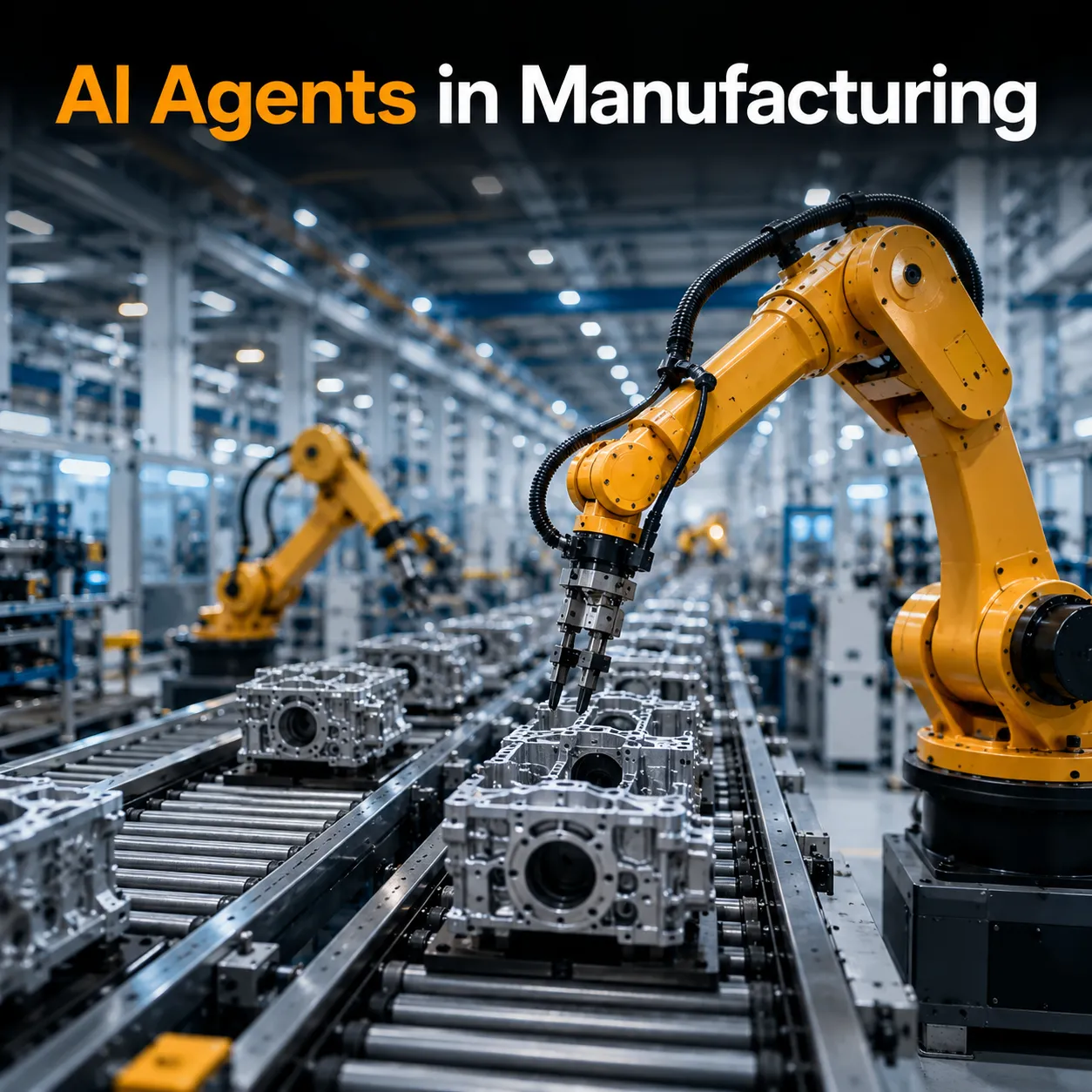
AI agents in manufacturing deliver ROI when deployed on one specific workflow first, not through plant-wide transformation. Manufacturers achieving results in 2026 identified the workflow with the clearest pain point, deployed a governed agent against it, and scaled from there.
What AI Agents Actually Are on the Manufacturing Floor
AI agents in manufacturing deliver ROI when you deploy them on one specific workflow first, not when you attempt a plant-wide transformation. McKinsey reports that manufacturers using agentic AI have achieved a 20 percent drop in inventory and logistics costs. Siemens has deployed its Industrial Copilot across its own factories and customer sites, moving from copilot assistance to semi-autonomous agents that execute complete industrial workflows.
The manufacturers getting results in 2026 did not start with a comprehensive AI strategy. They identified the workflow with the clearest pain point and the most measurable outcome, deployed a governed agent against it, and scaled from there.
What an AI Agent Is (and Isn't)
An AI agent in manufacturing is an autonomous software system that perceives operational data from sensors, systems, and documents, reasons through multi-step decisions, and takes actions without requiring human input at each step. It updates ERP records, sends alerts, schedules maintenance, routes exceptions, and logs every action for audit.
This is not a chatbot. A chatbot answers questions. This is not RPA. RPA follows fixed scripts and breaks when conditions change. An AI agent handles variable conditions, applies business rules, and escalates to humans when confidence drops below a set threshold.
The Three-Layer Architecture
The architecture has three layers:
- Context engine — connects to your ERP, SCADA, MES, CMMS, and sensor feeds and normalizes the data in real time.
- Agent reasoning and orchestration — where individual agents are configured with objectives, tools, and governance rules.
- Action and audit — where agents write back to systems and log every decision.
Human-in-the-loop controls sit at every layer. Agents operate autonomously within defined parameters and escalate when exceptions exceed those parameters. This governance architecture is what makes AI agents deployable in regulated or high-stakes manufacturing environments.
Where AI Agents Fit Across Manufacturing Operations
AI agents produce value across twelve functional areas. The highest-impact opportunities sit in repetitive, data-intensive, or document-heavy workflows where human review is still required but manual assembly wastes hours.
| Function | Highest-Value Agent Workflows |
|---|---|
| Production planning | Master production schedule build-and-rebalance, MRP exception triage, finite-capacity scheduling |
| Shop-floor operations | Work-instruction surfacing, Andon stop triage, OEE root-cause analysis, shift summary reporting |
| Quality management | Visual defect classification, CAPA plan drafting, NCR logging, FMEA refresh, audit pack assembly |
| Maintenance and reliability | Predictive maintenance alerting, failure pattern detection, work-order execution guidance, spares inventory optimization |
| Supply chain and logistics | DRP exception management, shipment delay narratives, freight tendering and audit, demand sensing |
| Sales and customer management | PO processing, ticket triage, warranty and RMA handling, quote drafting |
| Finance and cost management | Invoice processing, collections, month-end reconciliation, variance analysis |
| EHS and compliance | Incident reporting, corrective-action tracking, regulatory submission drafting, audit preparation |
The pattern across every function is the same. The agent does not replace the engineer, planner, or quality manager. It handles data retrieval, drafting, classification, and routing so the human can focus on judgment and decision-making.
The Five Highest-ROI AI Agent Use Cases in Manufacturing
These five use cases produce documented returns and are practical starting points for most manufacturers.
Use Case 1: Predictive Maintenance Alerting and Work Order Generation
A predictive maintenance agent monitors vibration, temperature, and current draw from equipment sensors. It correlates trends against historical failure patterns, cross-references maintenance schedules, identifies the nearest qualified technician, and raises a work order in your CMMS before the shift supervisor finishes their coffee.
What the agent does:
- Reads sensor data from PLCs and historians in real time
- Detects anomaly patterns that precede known failure modes
- Retrieves asset history, maintenance records, and technician certifications
- Drafts a work order with recommended parts and estimated downtime
- Routes the work order to the qualified technician and alerts operations leadership
Why it works: The agent compresses the time between anomaly detection and maintenance action from hours to minutes. It eliminates the manual synthesis of data from the CMMS, historian, and process quality dashboard that currently consumes reliability engineer time.
Real outcome: Manufacturers report 30 to 50 percent reduction in unplanned downtime when predictive maintenance agents are deployed with proper governance and human approval gates.
Use Case 2: Visual Quality Inspection and Defect Root-Cause Analysis
A vision-based AI agent classifies defects on the production line using camera feeds, correlates inspection outcomes with upstream process variables like temperature and pressure, and identifies root causes without waiting for end-of-shift review.
What the agent does:
- Analyzes real-time camera feeds against trained defect models
- Classifies defects by type and severity
- Correlates defect clusters with specific machines, shifts, or material lots
- Drafts a summary for quality engineers with recommended corrective actions
- Routes high-severity defects for immediate human review
Why it works: Human visual inspection is inconsistent across shifts and fatigues over time. An AI agent maintains the same standard at hour one and hour eight. It also catches patterns humans miss, like a gradual drift in defect rate that correlates with a specific tooling change.
Real outcome: Defect detection rates improve 40 to 60 percent over manual inspection, and root-cause identification time drops from days to hours.
Use Case 3: Production Schedule Rebalancing
A production scheduling agent analyzes order backlogs, machine capacity, material availability, and shift constraints. It generates a proposed schedule, flags potential violations, drafts a change narrative, and routes the schedule to planners for approval.
What the agent does:
- Reads sales orders, forecast data, and prior production volumes from the ERP
- Identifies capacity gaps and bottleneck conflicts
- Generates a proposed weekly master production schedule
- Drafts the rationale for each change
- Routes the proposal to the production planner with flagged exceptions
Why it works: Planners currently spend most of their time assembling schedules from fragmented data sources. The agent handles the assembly. The planner handles the exceptions, capacity adjustments, and operational judgment.
Real outcome: Schedule generation time drops from half a day to under 30 minutes, and planners can run more frequent rebalancing cycles in response to disruptions.
Use Case 4: Purchase Order Processing and Three-Way Matching
A PO processing agent extracts data from customer purchase orders, validates them against product configurations and pricing rules, flags mismatches, drafts order confirmation letters, and routes exceptions to the sales or operations team.
What the agent does:
- Reads incoming POs from email, EDI, or portal uploads
- Extracts line items, quantities, pricing, and delivery requirements
- Validates against active product configurations and contract terms
- Performs three-way matching against purchase orders and receipts
- Flags discrepancies and drafts exception summaries for review
Why it works: PO processing is high-volume, rules-based, and error-prone when done manually. An agent handles the standard cases instantly and escalates only the exceptions that need human judgment.
Real outcome: Documented deployments show approximately 90 percent faster document and tender processing, with elimination of manual monitoring across routine procurement workflows.
Use Case 5: CAPA Plan Drafting and Non-Conformance Tracking
A CAPA agent aggregates defect data and non-conformance reports, generates root-cause analyses using prior cases, drafts 8D containment and corrective actions, tracks completion status, and summarizes effectiveness for review.
What the agent does:
- Reads non-conformance reports from the quality management system
- Retrieves prior CAPAs for similar defect types
- Drafts Five-Whys and fishbone analysis narratives
- Generates 8D reports with containment, corrective, and preventive actions
- Tracks completion status and escalates overdue items
Why it works: CAPA documentation is repetitive, document-heavy, and critical for audit readiness. Quality engineers spend hours assembling reports that an agent can draft in minutes. The engineer reviews, corrects, and approves rather than starting from a blank page.
Real outcome: CAPA drafting time drops 70 to 80 percent, and audit readiness improves because documentation is consistently complete and traceable.
The Practical Implementation Roadmap
Most AI agent projects fail in the gap between demo and production. The manufacturers succeeding in 2026 follow a six-step sequence.
Step 1: Identify One Use Case With Clear ROI
Pick the metric you want to move. OEE, uptime, reactive maintenance percentage, order processing time. Work backward to the workflow that moves it. Bring operations, IT, and quality stakeholders to the table before you select technology. A shared work plan that everyone owns protects the rollout.
Step 2: Fix Your Data Foundation
Eight in ten companies cite data limitations as the primary roadblock to scaling agentic AI. The agent cannot make accurate decisions on inconsistent or poorly structured data. Clean your ERP records, normalize sensor feeds, and establish data ownership before you build the agent. Modern foundation models can accelerate data cleaning, but they cannot replace governance.
Step 3: Define Guardrails and Decision Rights
Require human sign-off before the agent generates or closes a work order. Set confidence thresholds below which the agent flags findings for expert review. Define escalation rules so critical faults route to named individuals rather than general queues. Engineering, quality, and operations approval must remain mandatory for shutdowns, critical process changes, and product release.
Step 4: Upskill Your Team for AI Collaboration
The World Economic Forum reports that 39 percent of existing skill sets will transform or become outdated by 2030, and 63 percent of employers point to skill gaps as the largest barrier to business transformation. Train your operators and engineers to ask the right questions, read agent outputs with judgment, and give feedback. Pair rollouts with short, hands-on enablement tracks. Use early wins to bring everyone forward.
Step 5: Pilot With One Persona in One Location
Deploy the agent for one role at one site. Measure machine coverage per engineer, mean time to repair, and the share of work orders the agent drafted accurately. Document the wins. When a technician catches a developing fault two weeks earlier than they would have otherwise, track it. These proof points build the business case for expansion.
Step 6: Assess Maturity Before Scaling
Score each site against its data foundation, change-management readiness, and integration map. Once an agent works in isolation, the next question is how your agents communicate with each other. A reliability agent that surfaces a fault needs to connect to a maintenance agent that schedules the fix, which coordinates with an operations agent managing active production commitments. That handoff requires shared context, clear ownership, and defined escalation logic. Think of it as staffing an industrial AI workforce the same way you staff a high-functioning operations team.
Why Most AI Agent Deployments Fail
- Starting with too many use cases. A plant-wide agent initiative collapses under its own weight. Start with one workflow, prove ROI, and expand.
- Building on dirty data. An agent running on messy ERP data produces messy results. Data cleaning is not a future phase. It is prerequisite work.
- Skipping governance. Full autonomy without approval gates, confidence thresholds, and audit trails creates liability. Manufacturing is not a chatbot use case. A wrong maintenance recommendation can cost millions.
- Treating it as an IT project. AI agents change how operators, planners, and quality engineers work. If operations does not own the rollout, adoption fails.
- Expecting immediate perfection. Agents improve with feedback. The first draft of a CAPA report or schedule proposal will need human correction. The value is in the time saved on drafting, not in eliminating review.
Build vs. Partner: What Manufacturing Leaders Should Know
Building AI agents in-house requires data engineering, ML ops, industrial systems integration, and governance expertise. Most manufacturers have deep operational knowledge but lack the full-stack AI engineering capacity to move from pilot to production in under six months.
The manufacturers seeing results in 2026 partner with firms that bring the integration layer, the agent orchestration framework, and the governance controls while the manufacturer brings the domain expertise and the data.
The right partner does not sell you a platform and leave. They scope the engagement around your specific workflow, connect to your existing ERP and MES systems, build the approval gates your quality team requires, and hand the system over so your engineers can manage it.
If your reliability engineers are still pulling data manually from three different screens to diagnose a fault, your planners are spending half their day assembling schedules from spreadsheets, or your quality team is writing CAPA reports from scratch, the bottleneck is not your people. It is the lack of autonomous systems that handle the repetitive synthesis and drafting work.
At Octopus Builds, we design and deploy AI agents for manufacturers that connect to your SCADA, ERP, CMMS, and quality systems. We build the context engine, the agent reasoning layer, and the governance controls so your team stays in command while the agent handles the data retrieval, analysis, and drafting.
If you are ready to move from pilot to production with AI agents that actually run on your shop floor, build with Octopus Builds. We will show you how to start with one workflow and scale from there.
Ready to deploy your first AI agent?
At Octopus Builds, we design and deploy AI agents for manufacturers that connect to your SCADA, ERP, CMMS, and quality systems. We build the context engine, the agent reasoning layer, and the governance controls so your team stays in command while the agent handles the data retrieval, analysis, and drafting.
If you are ready to move from pilot to production with AI agents that actually run on your shop floor, build with Octopus Builds. We will show you how to start with one workflow and scale from there.
Build with Octopus Builds
Need help turning the article into an actual system?
We design the operating model, product surface, and delivery plan behind AI systems that need to ship cleanly and keep working in production.