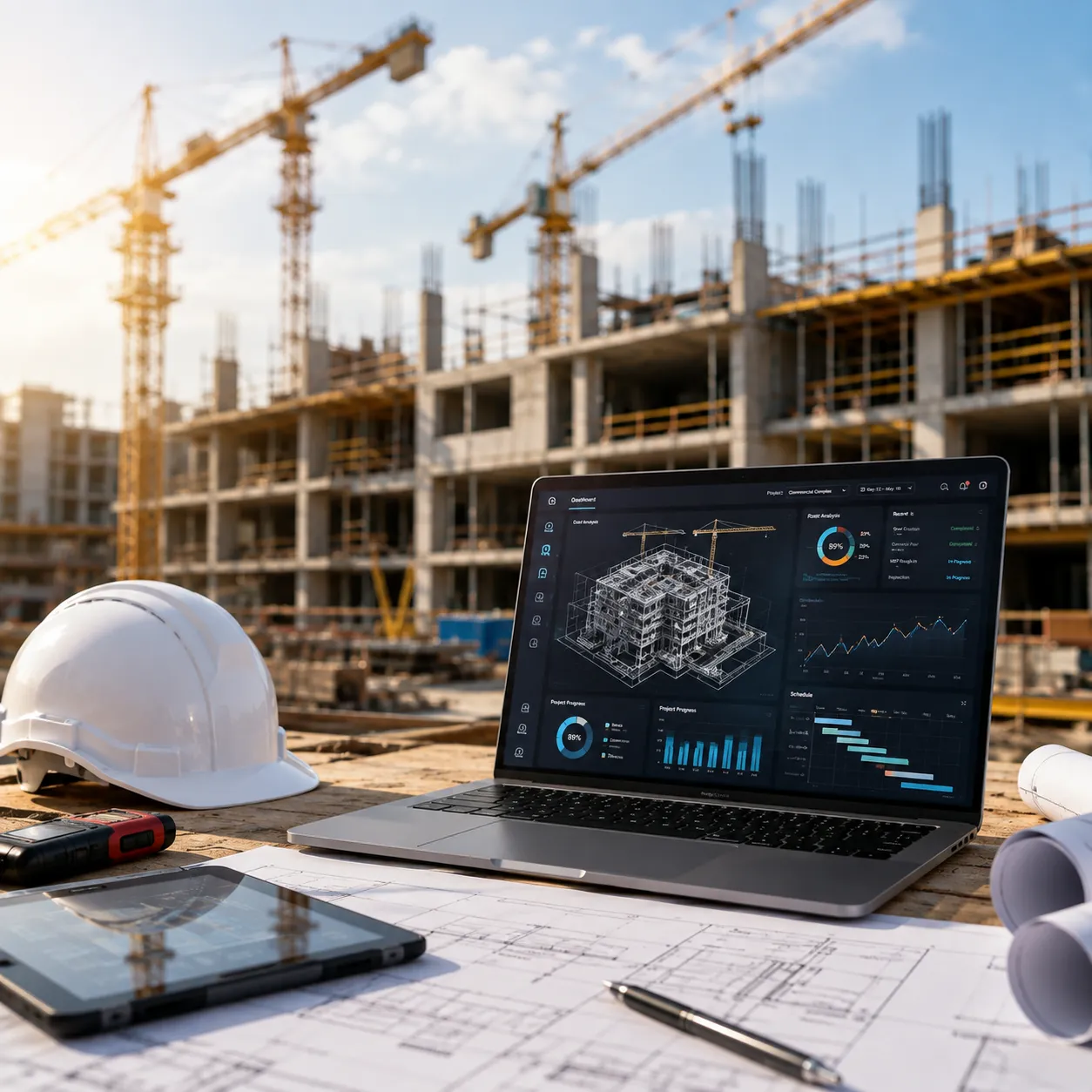
Only 27 percent of architecture, engineering, and construction firms reported using AI for automation in 2026, yet 94 percent of adopters plan to increase spending. The gap is widening: rework costs 5 to 9 percent of project totals, and AI automation can compress schedules by 15 to 30 percent while cutting safety incidents by more than 40 percent.
Why construction automation matters now
The gap between the firms using AI and the firms watching is widening every quarter. Construction accounts for roughly 13 percent of global GDP and remains one of the least digitized sectors. Global construction productivity improved only about 10 percent between 2000 and 2022, roughly a fifth of the rate the wider economy managed.
Rework alone costs 5 to 9 percent of total project cost. Roughly 30 percent of the work performed on a typical jobsite is rework. AI automation directly addresses this by catching coordination failures before they reach the field, compressing schedules by 15 to 30 percent, and reducing safety incidents by more than 40 percent.
The companies on this list were selected because they develop AI systems specifically for construction operations, not because they added a construction landing page to their generic software practice. Each entry covers what they actually build, who they are genuinely suited for, and where their limits are.
AI development companies for construction automation: Comparison at a glance
| Company | Location | Best For | Notable Strength |
|---|---|---|---|
| Octopus Builds | Global delivery | Contractors needing custom AI agents connected to real project systems | 72-hour scoping, 2-week sprints, full-stack from agent logic to production hardening |
| Crunch-IS | Global delivery | Firms needing AI document intake and BIM intelligence built by engineers with construction domain experience | 70 to 80% faster document ingestion; custom-trained R-CNN models for BIM/PDF analysis |
| ALICE Technologies | Menlo Park, CA | Large capital projects needing generative schedule optimization | McKinsey partnership; up to 40% schedule reduction; Stanford research pedigree |
| Buildots | Global (Israel HQ) | GCs and owners running large commercial projects who need automated progress verification | Up to 50% delay reduction; $166M raised; deployed on $45B+ in projects |
| OpenSpace AI | San Francisco, CA | Teams needing visual site records with AI-powered location tracking and progress metrics | 15-minute processing; AI AutoLocation like indoor GPS; MIT Media Lab founders |
| Doxel | Global (HQ Palo Alto) | Data center and mission-critical builders needing AI progress tracking and risk prediction | 11% faster project delivery; computer vision + BIM integration; Andreessen Horowitz backed |
| SoftServe | Global (HQ Austin, TX) | Organizations building AI-enabled construction technology products with robotics and autonomous systems | 85% YoY AI practice growth; 30 to 70% cycle time reduction with multi-agent systems |
| EPAM Systems | Global (HQ Newtown, PA) | Enterprises modernizing legacy project management platforms with AI and cloud-native engineering | Forrester-recognized platform engineering; Anthropic partnership for enterprise AI delivery |
The detailed profiles that follow break down what each company builds, their delivery approach, and who they serve best.
Best AI development companies for construction automation in 2026
1. Octopus Builds
Construction AI projects fail when the development team treats the jobsite as an afterthought. An AI agent that classifies RFIs correctly in a test environment breaks when it encounters a subcontractor email chain with 14 nested replies, a photo attachment named IMG_4472.jpg, and a revision reference that does not match the drawing set. Octopus Builds designs for that reality from day one.
The firm is the Ellenox services arm for AI systems and software delivery. Its construction automation practice centers on building AI agents that read from the actual systems running your projects: Procore, Autodesk Construction Cloud, Oracle P6, SharePoint, and proprietary document repositories. Where most AI shops train models on clean datasets and hand over code, Octopus Builds trains agents on your messy production data, handles the integration edge cases, and hardens the system for the security and compliance requirements that matter once you are live.
What they build
- AI document intake agents that read incoming project emails, classify RFIs, submittals, and change orders, and log them directly into Procore or Autodesk Construction Cloud without the manual download, classify, and upload cycle
- BIM intelligence agents that extract, validate, and structure data from DWG drawing sets, replacing manual tag searches and error-prone Excel indexes with queryable instrument databases
- Schedule risk agents that analyze Oracle P6 or MS Project files, identify logic conflicts and slippage patterns, and draft intervention recommendations for project controls teams
- Progress verification pipelines that combine 360-degree site imagery with BIM models to compute percent complete by trade and flag variance against the schedule
- Safety compliance agents that read daily reports, inspection checklists, and incident forms to flag missing documentation and draft corrective action plans
Delivery model
| Metric | Detail |
|---|---|
| Initial scoping | Within 72 hours of first contact |
| Sprint cadence | Working software delivered every two weeks |
| Typical time to first production deployment | 4 to 12 weeks |
| Integration scope | Procore, Autodesk, Oracle P6, SharePoint, custom ERPs, and sensor platforms |
| Data governance | SOC 2, HIPAA, and GDPR frameworks built in from day one |
| Handoff | Full documentation, team training, and 30-day support window |
Best for: general contractors, specialty contractors, and construction managers who have outgrown off-the-shelf platforms or who need AI automation that connects to systems their competitors cannot replicate.
2. Crunch-IS
Crunch-IS is an AI-enabled custom software engineering company with direct construction deployments across document automation, BIM intelligence, and compliance platforms. The firm emphasizes engineers with construction domain experience rather than generic AI talent parachuted into the industry.
For a U.S. general contractor with over 70 years of experience, Crunch-IS designed and deployed an AI email agent for construction document intake. The agent intercepts incoming project emails, classifies RFIs, submittals, and change orders, and logs documents directly into Procore and SharePoint. The result was 70 to 80 percent faster document ingestion and 35 hours per month of manual administrative work eliminated. The project delivered in 3.5 months by a team of four, integrated with Microsoft Azure, Procore API, and Microsoft Graph.
In a parallel engagement, Crunch-IS built an AI-powered DWG intelligence agent for a mid-sized construction engineering company. The cloud-native agent, built on AWS and Autodesk Platform Services, automatically extracts, validates, and structures instrument data from DWG drawing sets. Engineering teams eliminated manual DWG review entirely.
What they build
- AI email agents for construction document intake and classification
- DWG intelligence and BIM data extraction agents
- AI-enhanced compliance learning management systems using RAG architecture
- Custom-trained computer vision models for construction document analysis
Best for: engineering and construction firms that need AI development partners who understand document control, submittal workflows, and the complexity of multi-party project environments.
3. ALICE Technologies
ALICE Technologies is the creator of the first AI-powered platform for construction schedule optimization. Founded in 2015 and born from Stanford research, the platform uses generative algorithms to produce millions of possible execution paths and identify the most efficient options.
In April 2026, McKinsey announced a partnership with ALICE to offer generative scheduling software to contractors across infrastructure and construction. The offering analyzes BIM models and Oracle P6 schedules to generate optimized execution paths. The two companies have introduced the technology to more than 35 clients in infrastructure, data centers, energy, and manufacturing, achieving schedule acceleration of up to 20 percent.
Documented client results include a Zachry Construction highway project reduced by 28 days and a McKinsey data center client that reduced construction schedule by 40 percent.
What they build
- Generative scheduling that ingests BIM models and P6 schedules to produce optimized execution paths
- What-if scenario planning that treats labor, equipment, materials, space, and sequence as adjustable variables
- Resource curve optimization and productivity assumption modeling
Best for: large capital project contractors, infrastructure builders, and data center developers running complex schedules with thousands of activities and multiple interacting constraints.
4. Buildots
Buildots is a construction intelligence platform that uses 360-degree helmet-mounted cameras worn by site managers to continuously capture the as-built state of construction. Computer vision AI processes the imagery and combines it with schedule, BIM, and project management data to produce predictive metrics including delay risk forecasts, productivity benchmarks, and root cause analysis.
The platform has been deployed by Fortune 500 contractors including Turner Construction and JE Dunn. Buildots has demonstrated results reducing project delays by up to 50 percent, equivalent to 2 to 3 months on average-sized projects. The company has raised $166 million in funding and operates across 12+ countries.
What they build
- 360-degree site capture and computer vision progress verification
- Predictive delay risk forecasting by trade, location, and time period
- Automated quantity surveying and variance detection against BIM
- Productivity benchmarking and root cause analysis
Best for: general contractors and construction managers running large-scale commercial or infrastructure projects who need automated, data-driven visibility into on-site progress.
5. OpenSpace AI
OpenSpace AI is a visual intelligence platform founded by MIT Media Lab alumni. The company makes it easy to capture complete visual records of construction sites using 360-degree cameras, drones, smartphones, and laser scanners. Its AI AutoLocation functions like indoor GPS, automatically pinning observations to the correct location on a drawing directly from a smartphone.
Captured walkthroughs are processed in an average of 15 minutes, giving teams near-real-time access to site conditions. The platform integrates with Procore and Autodesk, converting visual data into metrics like percent complete, schedule tracking, and productivity insights.
What they build
- 360-degree visual site capture with AI-powered location tracking
- Progress tracking and percent-complete metrics from visual data
- Integration with construction management platforms for automated reporting
- AI AutoLocation for indoor positioning without GPS
Best for: project teams that need fast, accurate visual records of site conditions with automated progress metrics and drawing-based location intelligence.
6. Doxel
Doxel provides automated construction progress tracking using AI-powered computer vision and BIM integration. The platform acts as a digital surveyor, capturing 360-degree imagery and comparing actual work completed against the planned schedule to provide objective, real-time progress data.
Doxel proactively identifies construction risks, applies AI to analyze potential solutions, and provides recommendations that speed up project delivery by an average of 11 percent. The platform is particularly strong in data center and mission-critical construction, with partnerships including Corscale and deployments on gigawatt-scale developments.
What they build
- AI-powered work-in-place tracking across 75+ construction stages
- Production rate data and productivity forecasting
- Schedule risk identification and resource allocation recommendations
- Integration with Primavera P6 for milestone and progress synchronization
Best for: data center developers, mission-critical builders, and owners who need objective progress verification and early risk identification on large capital projects.
7. SoftServe
SoftServe is a digital engineering company with an AI practice growing 85 percent year over year and over 150 specialists on agentic AI and data science projects. The company's Physical AI work integrates robotics, autonomous systems, and generative AI in industrial and infrastructure environments where AI must interact with the physical world.
SoftServe reports that multi-agent systems reduce software development cycle time by 30 to 70 percent, handling architecture proposals, module generation, and documentation. For construction technology companies building AI-enabled products, this engineering depth matters.
What they build
- AI-enabled construction technology products with robotics and autonomous systems integration
- Multi-agent systems for architecture proposals and module generation
- Physical AI solutions for industrial and infrastructure environments
- Generative AI for design and engineering workflows
Best for: construction technology companies and product builders that need deep engineering partners to develop AI-enabled hardware and software solutions, rather than contractors seeking operational automation.
8. EPAM Systems
EPAM Systems is a global digital engineering company recognized by Forrester for best-in-class platform engineering capabilities and above-par AI and data governance. In October 2025, EPAM launched AI/Run, its enterprise AI delivery framework. In May 2026, the company announced a strategic multi-year partnership with Anthropic to accelerate enterprise-grade AI delivery.
EPAM's primary depth is in enterprise platform engineering across financial services, healthcare, and retail. Construction-specific domain software is not a named vertical, but the firm's engineering capability is relevant for large construction enterprises modernizing legacy project management platforms with AI and cloud-native architecture.
What they build
- Enterprise AI platform engineering and cloud-native development
- Legacy system modernization with AI integration
- AI/Run framework for enterprise AI delivery
- Data governance and MLOps infrastructure
Best for: large construction enterprises and owner-developers with substantial legacy platform estates that need enterprise-grade AI engineering and modernization rather than niche construction workflow automation.
Ready to move from demo to production-grade construction automation?
Most AI development projects fail in the gap between the prototype and the operating environment. A model that classifies documents accurately in a test dataset is useless if it cannot read your subcontractor email chains, parse your DWG files, or write back to your Procore project.
Octopus Builds works with contractors and construction managers who need AI automation that actually runs in production: connected to your real project data, compliant with your real document control requirements, and handed over in weeks, not quarters.
We scope engagements in 72 hours, deliver working software every two weeks, and design for the integration requirements that matter once you are live.
Build with Octopus Builds
Need help turning the article into an actual system?
We design the operating model, product surface, and delivery plan behind AI systems that need to ship cleanly and keep working in production.