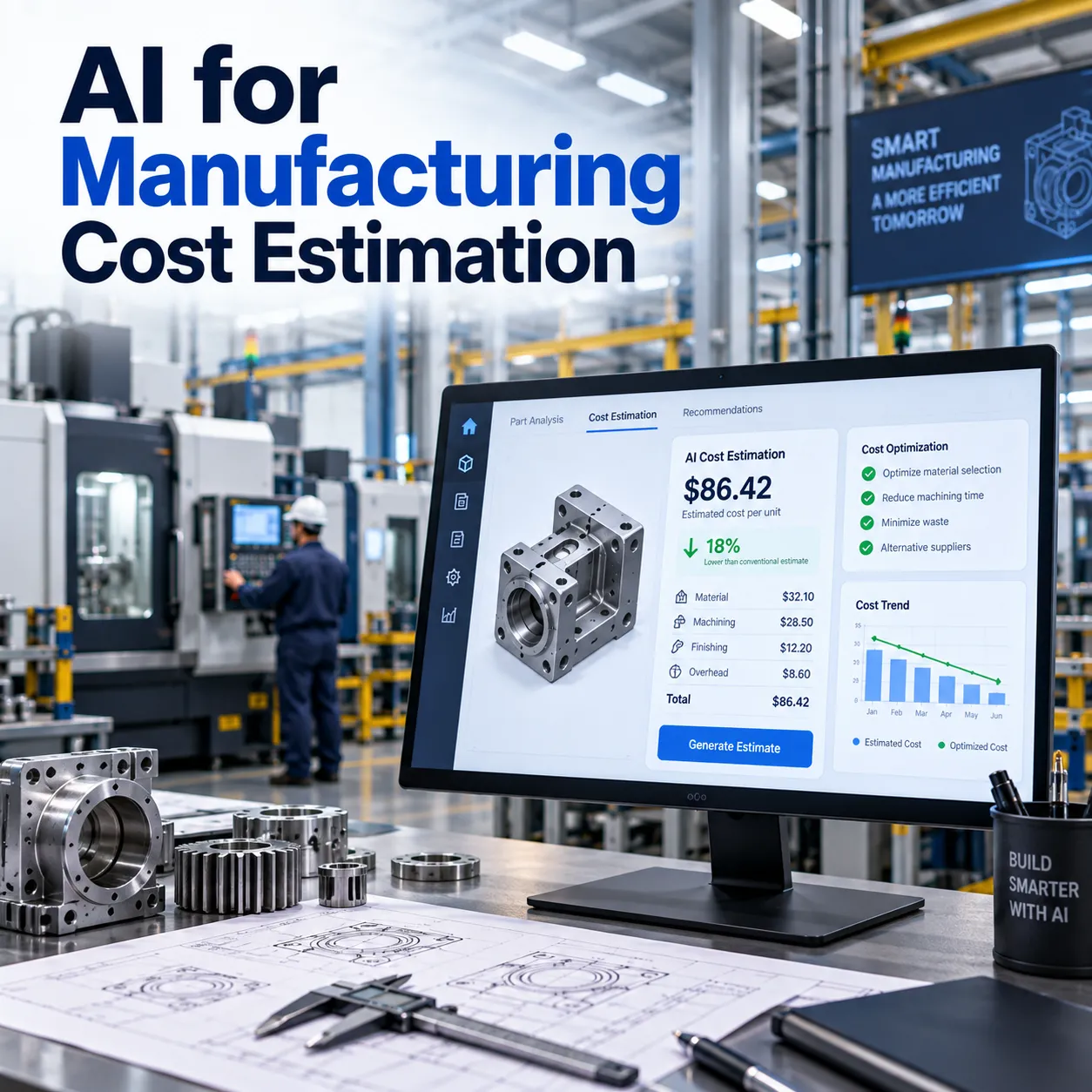
Every manufacturing quote starts the same way. A drawing lands, a cost engineer hunts through past jobs, checks machine rates, calls suppliers, and builds the estimate line by line in a spreadsheet. Two days later, the quote goes out, usually behind a faster competitor. AI in cost estimation is not about replacing engineering judgment. It is about removing the manual data collection and calculation work that fills the week and slows every quote down.
Introduction
The actual problem is that manufacturing cost estimation is still heavily manual, with engineers spending hours collecting data, checking past jobs, validating rates, and building estimates.
AI can automate this repetitive work without replacing the cost engineer's judgment. This article covers what AI can genuinely automate, what still needs human input, and how to build a reliable system around your existing workflow.
Why Cost Engineers Spend Time on the Wrong Work
Engineering design determines roughly 70 percent of final manufacturing cost, even though the engineering phase accounts for only 5 percent of total project cost. This is the leverage point in cost estimation. Decisions made early, with good cost data, prevent expensive corrections later.
Yet most cost engineers do not spend their time on early-stage cost analysis. They spend it on:
- Maintaining cost databases: updating raw material prices, labor rates, and machine hourly rates as suppliers and markets shift
- Building estimate templates from scratch for each new RFQ
- Chasing down current pricing for materials, tooling, and outsourced operations
- Manually calculating cycle times, setup times, and secondary operations
- Cross-referencing past projects to find comparable pricing history
- Rebuilding estimates every time engineering changes a tolerance, material, or geometry
A typical bottom-up estimate on a moderately complex machined part requires dozens of parameters to be simultaneously accurate: material cost, machining rate, cycle time, tooling cost, scrap rate, setup time, secondary operations, packaging, freight, overhead. If any one is stale, the whole estimate is misleading. Manual maintenance of that many variables at scale is the single biggest reason cost estimates come in wrong.
AI does not solve the judgment work in cost estimation. It solves the data maintenance work preventing engineers from getting to the judgment work.
What AI Can Automate in Manufacturing Cost Estimation
The specific parts of the workflow AI handles well in 2026:
- CAD-based feature recognition and cost prediction: AI reads a 3D CAD file, identifies features (holes, pockets, threads, tolerances, surface finishes), classifies the manufacturing operations required, and produces a first-pass cost estimate. Online manufacturing platforms like Xometry, Protolabs, and Fictiv have run this at scale for years. In-house AI feature recognition now brings the same capability to internal cost engineering teams.
- Historical cost retrieval and matching: given a new part or assembly, AI searches your project history for the most comparable jobs, pulls actual costs by operation, and surfaces the closest 5 to 10 matches with variance analysis. Institutional pricing knowledge that used to live in one senior engineer's head becomes accessible to the whole team.
- Real-time material price integration: AI monitors supplier catalogs, commodity indexes, and internal purchasing history to keep material cost data current. What used to be a quarterly manual update becomes a continuous feed.
- Machine cycle time prediction: AI trained on production data predicts realistic cycle times for new parts based on geometry, material, and machine capability. This replaces "similar part times about 12 minutes" guesswork with data-driven predictions that reflect your actual shop performance.
- Should-cost analysis and design feedback: AI compares current design costs against optimized alternatives and flags features that disproportionately drive cost. A tighter tolerance, an unusual material choice, or a hard-to-access feature gets identified with its cost impact, giving design engineers the information they need to iterate.
- RFQ document extraction: AI reads incoming RFQ packages (drawings, specifications, quality requirements, delivery terms) and extracts the structured data needed to build an estimate. Manual reading and re-typing of RFQ content is one of the largest hidden time sinks in the estimating workflow.
- Change comparison across revisions: when an engineering change or spec revision drops, AI compares the old and new versions and produces a summary of what changed and how the cost estimate needs to update. A two-hour manual re-estimate becomes a targeted update on the affected line items.
Where Human Cost Engineers Still Need to Own the Decisions
The parts of cost estimation that stay human, regardless of how good the AI gets:
- Pricing strategy on strategic accounts: whether to bid aggressively on a customer relationship worth $2M in future work, or protect margin on a spot buy. AI has no context on customer strategy.
- Manufacturing method selection: whether to machine a part from billet, cast it, or forge it. AI can compare costs across methods, but the final call factors in tooling amortization, volume commitments, and supply chain risk that require human judgment.
- Supplier and outsourcing decisions: which subcontractor to use, whether to make or buy, when to renegotiate a long-standing supply agreement. Relationship and market judgment, not extraction.
- Non-standard scope: a part with an unusual coating, a proprietary alloy, or a fixture that has to work around existing production constraints. AI does not have the pattern-matching for edge cases that senior cost engineers built over decades.
- Final estimate validation: before a quote goes to the customer, someone qualified confirms the numbers make sense. AI misses things, especially on parts outside its training distribution. The cost of missing something on a bid is high enough that human review is not optional.
The Three Biggest Time Sinks AI Cost Estimation Solves
For most manufacturing cost engineering teams, three specific parts of the workflow consume the majority of hours and are the highest-leverage automation targets.
The three biggest time sinks
Data maintenance and cost database updates
Cost engineers spend 20 to 40 percent of their time keeping the underlying data current. Material prices from suppliers, labor rates from HR, machine hourly rates from finance, scrap rates from production, overhead allocations from accounting. Each source updates on its own schedule. Each requires manual entry into the estimation system.
AI-driven data pipelines replace this. Supplier catalogs get scraped or API-integrated. Purchase order history flows into the material cost layer automatically. Machine hourly rates get pulled from your accounting system. What used to be a quarterly rebuild of the cost database becomes a continuous refresh.
The result is not just time saved. Estimates built on current data are more accurate and easier to defend when a customer questions a number.
Historical project retrieval and comparable pricing
Most manufacturers have 5 to 15 years of project history sitting in ERP data, quote logs, and job cost reports. In practice, only the senior cost engineer who was there for the original jobs can retrieve it, and only from memory.
AI retrieval indexes that project history and makes it queryable. A junior engineer can now find the closest comparable job from 2019 in seconds, along with what it quoted at, what it actually cost to produce, and where the variance came from.
This is the single most underrated benefit of AI in manufacturing cost estimation. It democratizes pricing knowledge and reduces the firm's exposure to senior engineer turnover.
CAD-based feature extraction and cycle time calculation
Reading a CAD file, identifying manufacturing features, and calculating cycle times has always been slow and inconsistent when done manually. Two engineers looking at the same part often produce different cycle times because they applied different rate assumptions.
AI feature recognition standardizes this. The same part produces the same feature list every time. Cycle time predictions come from trained models that reflect actual shop performance, not memorized rules of thumb.
For high-mix low-volume shops and on-demand CAD-driven quoting environments, this is where the largest time savings land.
Where AI delivers the largest time savings in cost estimation.
How AI Cost Estimation Fits Different Manufacturing Environments
Not every manufacturer has the same cost estimation problem. The right approach depends heavily on your production model.
| Manufacturing Environment | Primary Cost Estimation Challenge | Best AI Automation Target |
|---|---|---|
| High-volume production | Marginal cost optimization on established parts | Real-time material and rate updates, variance analysis |
| High-mix low-volume | Estimating dozens of unique parts weekly | CAD-based feature recognition and historical retrieval |
| Engineer-to-order (ETO) | Estimating parts that don't exist yet | Parametric cost models tied to design specifications |
| CAD-driven on-demand | Instant quote generation from customer uploads | Full-stack automated feature recognition and pricing |
| Custom fabrication | Non-standard geometries and materials | Should-cost analysis with human review gate |
| Contract manufacturing | Bidding against price-sensitive customers | RFQ intake automation and historical bid analysis |
The mistake most firms make is buying an AI tool designed for high-volume production and trying to apply it to high-mix low-volume work, or vice versa. The underlying models, data requirements, and workflow assumptions differ.
Why Data Quality Is the Real Blocker to AI in Cost Estimation
Academic research on AI-driven manufacturing cost estimation consistently identifies the same limiting factor: not the AI itself, but the availability and consistency of the underlying product and manufacturing data.
In plain terms: your AI is only as good as your data. If your material costs are scattered across spreadsheets and ERP records that disagree, if your machine hourly rates were last updated in 2022, if your project history lives in inconsistent formats, AI will produce inconsistent estimates.
Before deploying AI, most manufacturers need to invest in:
- Standardized cost coding: consistent categorization of materials, operations, and overhead across the entire history
- Clean historical project data: past estimates, actual costs, and outcome data structured in a way AI can learn from
- Integrated data sources: ERP, PLM, MES, and accounting systems connected so AI has access to current information, not stale exports
- Version control on cost data: clear tracking of when material prices, labor rates, and machine rates were updated and by whom
- Feedback loops from production: actual costs flowing back into the model so predictions improve over time
This foundation work is unglamorous. It is also the difference between AI that produces reliable estimates and AI that produces confidently wrong numbers.
Off-the-Shelf AI Cost Estimation Tools vs Custom-Built Systems
The honest picture on when to buy versus build.
Off-the-shelf works when:
- Your work is dominated by standard part types with well-established manufacturing methods
- Your ERP and PLM systems are common enough that pre-built integrations exist
- The AI tool's cost model assumptions roughly match how your shop actually operates
- You want to validate the ROI case before committing to a bigger investment
- CAD-based feature recognition on standard operations covers most of your estimating volume
Custom becomes the right call when:
- Your costing logic is proprietary and represents real competitive advantage
- A meaningful share of your work involves custom fabrication, unusual materials, or non-standard drawing conventions
- You need deep integration with a specific ERP, PLM, or CRM system that off-the-shelf tools don't support natively
- Your historical project data represents institutional knowledge you want captured in a system your team owns
- You've tried an off-the-shelf tool and it underperformed specifically on your work
Most manufacturers end up with a hybrid: off-the-shelf tools for the standard high-volume work, and a custom system for the higher-margin custom work where the off-the-shelf tools fall short.
Common Mistakes That Kill AI Cost Estimation Projects
Six patterns that turn a good AI initiative into a stalled project:
- Automating pricing decisions instead of data work: an AI that tries to set your markup or negotiate with customers will fail publicly. Start with data retrieval and calculation, not judgment
- Building on dirty historical data: inconsistent cost codes, duplicate part records, and missing project history produce unreliable AI output. Data cleanup is the prerequisite, not an afterthought
- Skipping the human review gate: teams that push for full automation without a cost engineer checkpoint see errors reach customers and cost margin within the first quarter
- Treating it as an IT project: cost engineers must own the workflow design. If IT defines what the AI should do, the output will not match how the shop actually estimates
- Expecting AI to compensate for missing manufacturing knowledge: AI trained without domain-specific inputs will miss the details experienced estimators catch. Manufacturing expertise still matters
- Rolling out firm-wide before piloting: the failure mode that kills initiatives. One cost engineer, one part family, six weeks. Then expand
Pilot checklist for AI cost estimation
Use this checklist to scope a low-risk pilot that proves value before scaling firm-wide.
Pick one part family
Start with a narrow, high-volume part family where current estimates are well understood and variance is trackable.
Clean one slice of historical data
Standardize cost codes and pull a clean sample of past estimates and actuals for that part family.
Keep a human review gate
A cost engineer reviews every AI-generated estimate before it goes to a customer, especially during the pilot.
Automate one data feed first
Pick the highest-friction data source (material prices, machine rates, or project history) and automate that first.
Measure quote cycle time and accuracy
Track how long each estimate takes and how AI-assisted estimates compare to historical accuracy on the same parts.
Expand only after six weeks of stable results
If the pilot holds up on accuracy and cycle time, extend to the next part family. If not, fix the data layer first.
Building a Custom AI Cost Estimation System That Fits Your Manufacturing Operation
If your cost engineers are spending more time updating spreadsheets and hunting through past projects than they are analyzing design decisions and negotiating with suppliers, the problem is not their capability. It is the lack of automation on the data layer that surrounds the actual estimating work.
Off-the-shelf tools cover the standard cases well. What most manufacturers actually need, especially the ones running custom fabrication, engineer-to-order work, or high-mix low-volume production, is a system built around their specific ERP, their proprietary cost data, their CAD conventions, and their approval workflows. That is where the margin protection lives and where generic tools underperform.
Octopus Builds designs AI cost estimation systems for manufacturers that connect to your existing ERP, PLM, and accounting platforms. We build the CAD feature recognition, historical retrieval, real-time cost data integration, and estimate generation workflow so your cost engineers stay in control while the repetitive data work gets handled automatically. Two-week scoping, working software delivered every two weeks, production hardening and system integration built in from day one.
Build with Octopus Builds
Need help turning the article into an actual system?
We design the operating model, product surface, and delivery plan behind AI systems that need to ship cleanly and keep working in production.