The fastest-growing capability in product development isn't a methodology, a framework, or a hire. It's the integration of generative AI tools across every stage of the lifecycle. The question is no longer whether AI belongs in product development. It's how to deploy it across the lifecycle in a way that compresses cycle times without producing review debt, model failures, or a tool sprawl that defeats the speed gains. This guide is that playbook.
What Is AI in Product Development?
AI in product development is the use of AI tools across every stage of the product lifecycle to accelerate research, design, engineering, testing, launch, and monitoring. The category covers generative AI (which produces new artifacts like PRDs, code, designs, and copy), predictive AI (which forecasts user behavior, ticket priority, or feature impact), and increasingly agentic AI (which executes multi-step workflows autonomously).
The 7 Stages of AI-Enabled Product Development
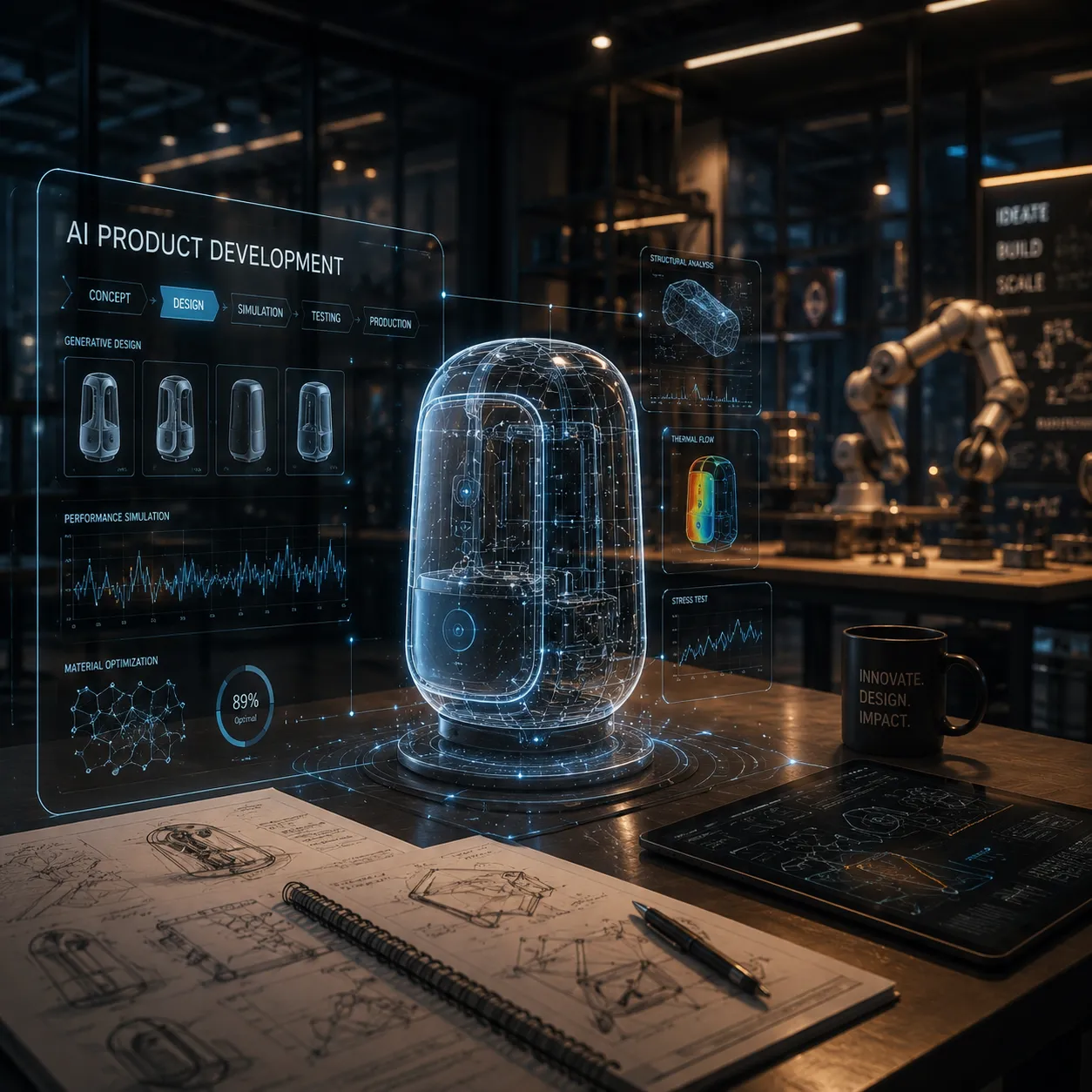
AI now plays a meaningful role at every stage of the product development lifecycle, not just engineering. The seven stages and what AI does at each:
1. Ideation and opportunity discovery:
Generative AI accelerates the messy front-end of product work: market research synthesis, competitive landscape mapping, opportunity sizing, and brainstorming feature directions. ChatGPT, Claude, and Perplexity now do in a single session what once required a contracted research firm or a week of internal analyst time.
2. User research and insights:
AI compresses the discovery-to-insight cycle dramatically. Dovetail's AI co-pilot, EnjoyHQ, and Marvin synthesize hundreds of user interviews into patterns and quotes in hours rather than weeks. Sentiment analysis on support tickets, sales calls (via Gong or Fireflies), and customer reviews surfaces themes that a human analyst would miss or take a month to find.
3. Requirements, PRDs, and roadmaps:
This is where the time savings are largest and most visible to leadership. A senior product manager who took four hours to write a PRD in 2023 now drafts the same document in roughly 30 minutes using ChatGPT, Claude, or ChatPRD, then spends the remaining time on judgment-intensive work like user discovery and prioritization. Productboard AI and Aha! Roadmaps AI automates intake triage, feature scoring, and roadmap drafting based on customer signal.
4. Design and prototyping:
The most dramatic shift in the design stage. Designers move from wireframes to Figma to prototype in a multi-day cycle to text-to-interactive-prototype in minutes using Figma AI, v0 by Vercel, Lovable, Bolt.new, and Galileo AI. The role of design has shifted toward curation and refinement of AI-generated options rather than building from scratch.
5. Engineering and coding:
The most-discussed shift and the one with the most contested ROI. Cursor (with Composer 2 agentic mode), Claude Code, GitHub Copilot, Windsurf, and OpenAI Codex now write 30 to 70% of new code at teams that have adopted them, according to public statements from Klarna, Brex, Linear, and Shopify engineering leaders. The bottleneck has moved from typing code to reviewing, integrating, and verifying it.
6. Testing, QA, and code review:
AI generates test cases, identifies edge cases, runs visual regression analysis, and flags review issues at scale. TestRigor, Mabl, Functionize, CodeRabbit, Greptile, and GitHub Copilot's PR review feature now handles work that previously required dedicated QA engineering effort. The catch is that AI-generated tests often miss the conditions that matter most.
7. Launch and post-launch monitoring:
AI shifts from production to operations after launch. Amplitude AI and Mixpanel AI surface anomalies and cohort patterns autonomously. PostHog's LLM observability layer monitors AI-feature performance in production. LangSmith and Helicone track AI behavior, prompt drift, and cost. Customer support AI (Intercom Fin, Zendesk AI, Ada) handles tier-1 questions and routes escalations to the product team only when the issue actually warrants their attention.
AI Tools for Product Development: The 2026 Stack by Stage
The AI product development stack splits cleanly by lifecycle stage. The named tools below are the ones consistently showing up in shipped enterprise rollouts in Q1 and Q2 2026. Pricing is monthly per seat unless noted.
| Stage | Best-in-class AI tools (2026) | Primary use case | Indicative pricing |
|---|---|---|---|
| Ideation and research | ChatGPT (GPT-5.3), Claude (Sonnet 4.6 / Opus 4.7), Perplexity, Gemini 3.1 Pro | Market research synthesis, brainstorming, and competitive analysis | $20-$200/seat |
| User research synthesis | Dovetail AI, EnjoyHQ, Marvin, Notably | Interview synthesis, theme extraction, quote sourcing | $30-$100/seat |
| PRDs and requirements | ChatPRD, Notion AI, ChatGPT, Claude | PRD drafting, structuring, edge-case enumeration | $20-$50/seat |
| Product management workflow | Productboard AI, Aha! Roadmaps AI, Linear AI, JIRA AI | Roadmap drafting, intake triage, feature scoring | $20-$200/seat |
| Design and prototyping | Figma AI, v0 by Vercel, Lovable, Bolt.new, Galileo AI, Uizard | Text-to-design, interactive prototypes, UI generation | $20-$100/seat + usage |
| Engineering (IDE-integrated) | Cursor (Composer 2), Claude Code, GitHub Copilot, Windsurf, Codex, JetBrains AI Assistant | Code generation, refactoring, and in-IDE assistance | $20-$200/seat |
| Engineering (autonomous agents) | Claude Code (CLI mode), Cursor Background Agents, Codex, Google Antigravity, JetBrains Junie | Autonomous coding tasks, PR generation, refactor sweeps | Usage-based |
| Testing and QA | TestRigor, Mabl, Functionize, GitHub Copilot for tests, Octomind, CodeRabbit, Greptile | Test generation, visual regression, E2E maintenance, PR review | $50-$500/seat |
| Launch analytics | Amplitude AI, Mixpanel AI, PostHog, Hotjar AI | Anomaly detection, cohort insight, behavioral pattern surfacing | $0-$2,000/month |
| AI feature observability | LangSmith, Helicone, Braintrust, PostHog LLM Analytics | Eval harness, prompt drift detection, hallucination tracking | $0-$500/month |
| Customer support | Intercom Fin, Zendesk AI, Ada | Tier-1 ticket resolution, FAQ deflection, escalation routing | $0.99-$2/conversation |
How AI Is Changing Product Management Specifically
Product management is the role with the largest visible AI productivity gain and the most existential anxiety attached. The work is changing in three concrete ways.
Documentation is no longer the bottleneck: PRDs, RFCs, launch plans, roadmap drafts, status updates, customer-facing release notes, and stakeholder briefs all compress dramatically when ChatGPT, Claude, or ChatPRD produces the first version and the PM edits for judgment. A senior PM at a mid-sized SaaS company who spent perhaps 40% of their week writing in 2023 now spends roughly 15% on writing, with the saved time going to user research, stakeholder alignment, and prioritization.
Roadmap and prioritization decisions are more data-grounded: Productboard AI and Aha! Roadmaps AI ingests customer feedback from support tickets, sales call transcripts, NPS responses, in-app behavior, and competitive intel, then proposes feature priorities scored against business objectives. The PM's job shifts from "synthesize the inputs and produce a ranked list" to "evaluate the AI's ranked list and override where judgment differs." This is faster, but it also requires the PM to have the judgment to know when the AI is wrong.
User research synthesis is the most-leveraged area: Dovetail's AI co-pilot, EnjoyHQ, and Marvin convert hundreds of customer interviews, support tickets, and survey responses into themed insights with cited quotes in hours rather than weeks. The teams using these tools well are running 5 to 10 times more user research than they did in 2023 for the same headcount. The teams using them poorly are treating AI-generated insights as ground truth without verifying the source material, which produces confident, plausible, and occasionally wrong product decisions.
The 5 Real Risks of AI in Product Development
Every benefit of AI in product development comes with a corresponding failure mode. Five risks consistently show up in postmortems of teams whose AI rollout didn't produce what was promised.
1. Hallucination and plausible-but-wrong defaults:
AI tools (coding assistants, PRD drafters, design generators, research synthesizers) produce output that looks correct, demos cleanly, and passes a first-glance review. The work that previously came from a junior practitioner, where errors were visible (typos, awkward phrasing, obvious bugs), now arrives polished and confident, with errors that are harder to spot precisely because they're embedded in plausible work.
The signature failure: a PRD with a fabricated competitor analysis, a code module with an invented API endpoint, a research synthesis with a misattributed quote. The fix is structural: never accept AI output without verifying load-bearing facts, and treat polish as a signal to verify rather than a signal to ship.
2. Code-review debt:
AI ships code faster than humans can review it. When Cursor or Claude Code produces 200 lines of working-looking code in five minutes, the reviewer is now under pressure to either review at the same speed (which means rubber-stamping) or review properly (which means becoming a bottleneck that the team will route around).
The teams handling this best are reducing PR size, mandating that the AI-using author add explanatory commentary, and using AI-assisted PR review tools (CodeRabbit, Greptile, GitHub Copilot PR review) to surface issues that human reviewers can then evaluate.
3. Junior developer skill atrophy:
AI coding tools work best for engineers who already understand the fundamentals and can evaluate whether the AI's suggestion is correct. They work best for junior engineers who lack the foundation to catch AI errors and become dependent on the AI for tasks they should be developing intuition around.
Several engineering leaders have publicly raised this concern, and the early data is mixed: junior engineers adopt AI fastest, but several teams report measurably weaker fundamentals at the 12 to 18-month mark.
The fix is intentional friction: pair programming where the senior writes the code without AI while the junior watches, dedicated learning time on fundamentals, and code review that probes for understanding rather than just correctness.
4. IP leakage to third-party LLMs:
Every prompt to ChatGPT, Claude, or any external AI service is a potential disclosure. Without explicit enterprise tiers with data retention and training opt-outs (Claude Enterprise, ChatGPT Enterprise, Azure OpenAI, AWS Bedrock with no-training settings), proprietary code, customer data, and competitive information can flow into training datasets.
The remediation is governance, not refusal: most enterprise rollouts now mandate specific tiers (Claude Enterprise, ChatGPT Enterprise) with no-training contracts, prohibit free-tier use of consumer AI for work, and route sensitive data through internal LLM gateways that strip PII.
5. Tool sprawl that defeats the speed gains:
A team using ChatGPT, Claude, Cursor, Claude Code, Copilot, Productboard AI, Figma AI, v0, Lovable, Dovetail AI, and Amplitude AI is paying for a capability it isn't fully using and creating integration debt that slows the workflow.
The teams getting the most out of AI in product development standardize aggressively: one PM tool, one or two coding tools, one design tool, one analytics tool. The cost of evaluating every new AI tool that launches (and they launch weekly) is meaningful, and the cognitive overhead of switching between five overlapping tools eats most of the productivity gain.
Ready to Operationalize AI in Your Product Organization?
If your product organization is scoping an AI rollout, scaling an existing pilot to wider adoption, or building AI-powered features that need to run inside a real operating environment with security, observability, and governance built in.
We design, deploy, and operate enterprise AI systems for teams that need measurable business lift and a clean handoff from pilot to production.
Build with Octopus Builds
Need help turning the article into an actual system?
We design the operating model, product surface, and delivery plan behind AI systems that need to ship cleanly and keep working in production.