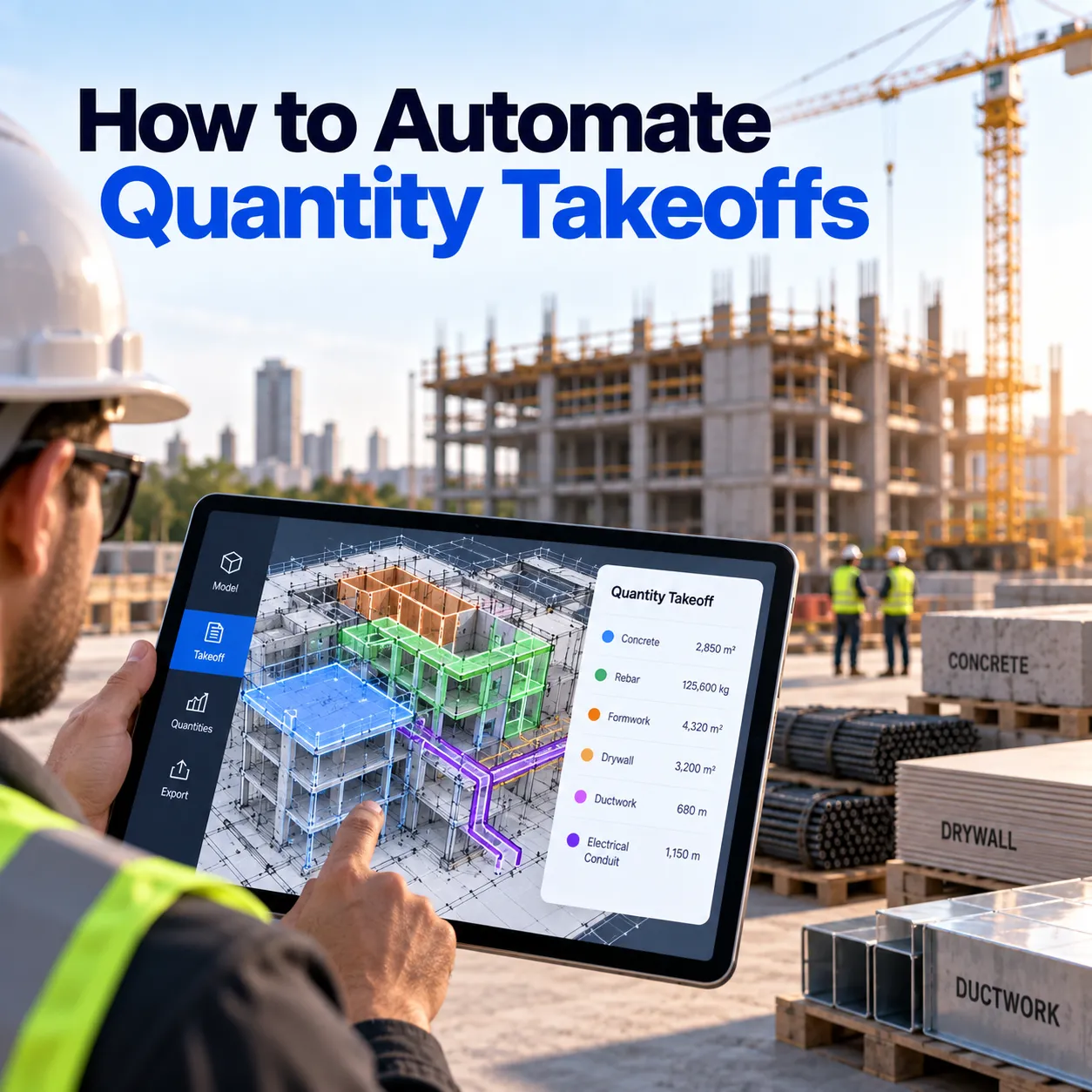
AI-powered takeoff tools can automate repetitive measurements, symbol counting, scale calibration, and revision comparisons. They can also reduce errors in the handoff to pricing, but they do not replace the estimator’s final review of ambiguous scope, non-standard drawings, and overall job quantities.
Introduction
"One bad estimate can run you out of business." That is how one electrical contractor put it on a trade forum, describing why he insisted on checking every estimate himself before it went out. Another contractor recounted a job where a 30-story apartment project shipped without the main disconnect (MI) accounted for in the takeoff. Nobody caught it until months after the job finished. The contractor ate the cost.
Takeoff mistakes are not abstract risk. They are the specific, expensive failure mode that estimating exists to prevent, and they happen most often on the part of the job everyone already knows is tedious: manually tracing walls, counting fixtures, and measuring runs off a plan set before pricing can even start.
This piece covers what AI-powered takeoff tools genuinely automate, where estimators still catch what software misses, what real accuracy looks like on different drawing types, and how to decide whether an off-the-shelf tool covers your workflow or your firm needs something custom.
Why Estimators Still Dread Takeoff Day
Ask any estimator what eats their week and the answer is consistent: the takeoff, not the pricing. Builders report spending 8 to 12 hours a week on quoting work overall, and the takeoff itself is the largest single chunk of that time on any non-trivial job.
The complaints that show up repeatedly in trade forums and software reviews point to the same underlying frustrations:
- Takeoff and pricing live in different tools, badly connected. A Capterra review of a popular takeoff platform put it plainly: "very quick to create a measured schedule but converting to a priced schedule is difficult." Another reviewer summarized the same split: "The takeoff element is very easy to use... the estimating element is not easy to use." Estimators get fast measurements and then hit friction turning those measurements into a number.
- Capacity, not skill, is the bottleneck. Contractors turn to outside estimating services specifically because, as one forum post explained, "they are usually used by contractors that are too busy for their estimators to get to it." The estimator isn't slow. There simply isn't enough estimator-hours to cover the bid volume.
- Small firms run takeoffs on instinct, not process. One project manager described his early career discovering just "how seat of the pants it all felt" at the companies he worked for, despite them somehow staying profitable. Manual takeoff without a repeatable process works until the one job it doesn't.
- A missed item on a takeoff is a margin-eating mistake, not a rounding error. The missed disconnect on the 30-story job wasn't caught by the estimator, the reviewer, or the GC. It surfaced only when the project was already finished and the cost had to be absorbed.
None of this is a knock on estimators. It's a description of a process that depends entirely on one person's attention holding up across every wall, every fixture, and every revision, on every single bid, with a deadline attached.
What AI Actually Automates in the Takeoff Process
The capabilities that modern AI-powered takeoff tools handle reliably in 2026:
Automatic detection of standard elements on digital plans. AI scans a PDF or CAD file and identifies walls, doors, fixtures, outlets, and pipe runs without an estimator tracing each one by hand. Tools built for this can generate area, linear, and count measurements in under a minute on a clean sheet.
Repeated symbol counting at volume. Instead of manually counting every outlet or every sprinkler head across a 40-page set, AI detects a symbol once and applies that recognition across every page in minutes, catching instances a tired eye might skip on page 32.
Automatic scale calibration. AI reads the drawing's scale notation directly and sets it, removing a common and completely avoidable source of error: an estimator setting the wrong scale and every downstream measurement being wrong as a result.
Revision comparison instead of full rework. When an addendum lands, AI compares the new sheet against the prior version and highlights exactly what changed. The estimator updates the affected quantities instead of redoing the entire takeoff from zero, which is what happens today in most manual workflows every time a drawing revises.
Quantities linked live into the pricing build. This is the fix for the exact complaint reviewers raised about disconnected takeoff and estimating tools. Measurement totals sync directly into a connected spreadsheet or cost engine, so a corrected quantity flows into the price automatically instead of requiring manual re-entry, which is itself a source of transcription error.
What Still Needs an Estimator's Eyes
AI takeoff removes the mechanical tracing work. It does not remove the need for a qualified person to sign off on the final numbers, and the trade forum stories above are exactly why.
Non-standard symbols and hand-marked changes. Drawings with unconventional legends, unusual trade-specific notation, or handwritten field changes require human interpretation. AI trained on standard symbology will miss or misread these.
Judgment calls on ambiguous scope. Whether a partial wall segment counts as full scope, how to treat an element split across two sheets, whether a symbol means one thing or another depending on context. These are the calls an experienced estimator makes instinctively and an AI model does not have the context to make correctly.
Low-resolution and scanned drawings. Detection accuracy depends heavily on input quality. A clean vector PDF and a scanned fax of a 1990s drawing are not the same problem for AI, even though they represent the same job to the estimator.
The final sanity check. Before a quantity goes into a bid, someone confirms it makes sense against the overall scope of the job. This is precisely the step that was skipped on the 30-story job where the disconnect went missing. AI does not replace that check. It changes how much material there is left to check, which is the actual point.
What Accuracy Actually Looks Like, By Drawing Type
Accuracy claims for AI takeoff tools vary widely, and the reason is almost always drawing quality, not the AI model itself.
| Drawing Condition | Typical Detection Accuracy |
|---|---|
| Clean, vector-based PDF plans | 95-99% on standard symbol counts |
| Scanned or low-resolution drawings | 80-88% |
| Hand-marked or heavily revised sheets | Lower, requires targeted manual review |
This is why confidence scoring matters more than headline accuracy numbers. A tool that flags its own uncertain detections tells the estimator exactly where to spend review time, instead of forcing a full re-check of every quantity out of general distrust, which defeats the purpose of automating in the first place.
When Off-the-Shelf Takeoff Tools Are Enough
Most firms will get real value from an off-the-shelf AI takeoff tool. The honest signal for when that's sufficient:
- Your plan sets use standard, recognizable symbology across most jobs
- Your workflow does not need the takeoff to write directly into a proprietary cost database or ERP
- You bid mostly standard, repeatable scope
- You want to solve the "takeoff and pricing don't talk to each other" problem without a custom build
When to Build Something Custom Instead
The signal that an off-the-shelf tool won't hold up for your firm:
- Your costing logic is proprietary and the takeoff needs to feed directly into it, not a generic template
- Your trade or region uses drawing conventions that don't match standard AI training data
- You need the takeoff output to write back automatically into your specific ERP without manual export and import, which is exactly the friction estimators complain about with generic tools
- Off-the-shelf accuracy has been inconsistent on your specific plan types
- You want your historical takeoff and bid data captured as something your whole team can query, not locked inside individual project files that only the original estimator remembers
How to Roll This Out Without Breaking What Already Works
Run one project through both methods first. Complete a takeoff manually and through the AI tool on the same job. Compare time spent and final quantities before trusting the tool on a live bid with money attached.
Pilot on your highest-volume, most standard project type. Standard symbology produces the most reliable detection, so start where the AI has the best chance to prove itself before testing it on your hardest jobs.
Decide your confidence threshold up front. Set the detection confidence level that triggers mandatory estimator review versus what can move straight to pricing. This is what keeps review time targeted instead of becoming a second full pass over everything.
Fix the takeoff-to-pricing handoff, not just the takeoff. If reviewers are still complaining that takeoff is easy but pricing is hard, a tool that only speeds up measurement without connecting to your cost build solves half the problem.
Expand once the pilot holds up. Move to more complex project types only after your team trusts the tool on standard work, and expect review time to increase proportionally with drawing complexity.
Building a Takeoff System That Fits How Your Firm Actually Bids
Octopus Builds builds takeoff and estimating systems that connect directly to your existing plan review, cost data, and ERP. Hence, the automation fits how your firm actually estimates instead of forcing your team to adapt around a generic tool. Two-week scoping, working software delivered every two weeks, and the human review step designed in from the start- not bolted on after a mistake makes it necessary.
If manual takeoffs are eating the hours your estimators need to price competitively, contact us.
Build with Octopus Builds
Need help turning the article into an actual system?
We design the operating model, product surface, and delivery plan behind AI systems that need to ship cleanly and keep working in production.