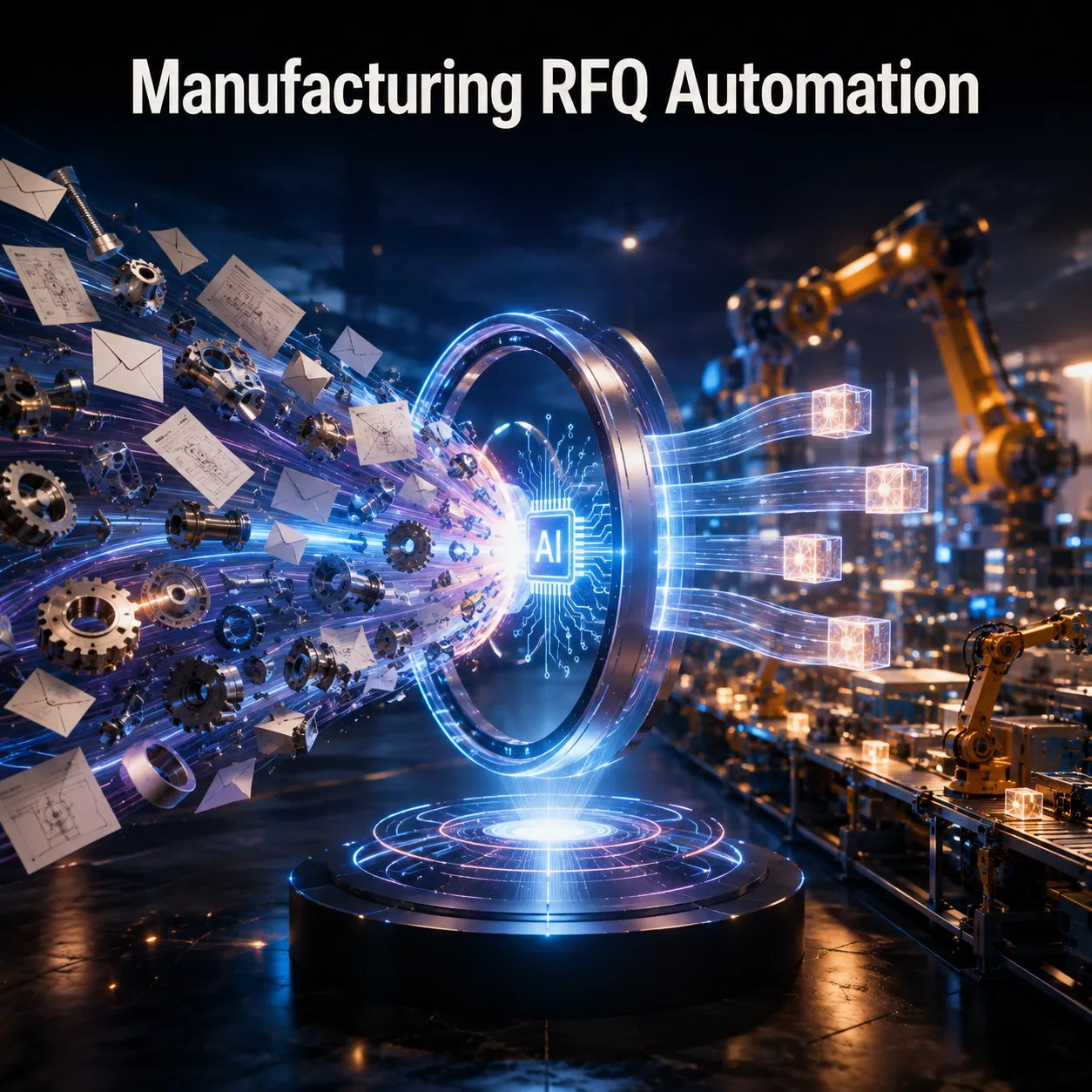
A $47,000 precision machining job lost to a competitor who quoted in four hours while your shop took three days- that's the cost of manual RFQ processes. RFQ automation fixes this bottleneck, and it's now practical for manufacturers beyond Fortune 500 operations.
What Is Manufacturing RFQ Automation?
An RFQ automation system reads an incoming request, pulls data from drawings and emails, checks material and labor costs against current rates, builds a quote, and sends it back. The human estimator reviews it, adjusts if needed, and hits send.
Here is the full flow:
| Step | What the System Does |
|---|---|
| RFQ arrives | Email, portal upload, or web form triggers the system |
| Drawings are read | AI extracts part geometry, material, tolerances, and quantity from PDFs and CAD files |
| Costs are checked | System pulls current material prices, machine run times, and labor rates from your ERP or database |
| Quote is built | System generates a priced quote with lead time and terms |
| Human review | Estimator checks assumptions, adds exceptions, and approves |
| Quote is sent | System delivers the quote to the buyer via email or portal |
| Follow-up is tracked | System logs status, sends reminders, and alerts on stalled deals |
The goal is not to remove the estimator. The goal is to remove the repetitive data entry, the spreadsheet hunting, and the manual math that eats up 80 percent of the quoting cycle. The estimator becomes a reviewer and strategist, not a data clerk.
The Hidden Cost of Slow Quoting for Manufacturers
Most shops track quote win rate. Few track quote speed as a leading indicator of revenue. They should.
When quoting is manual, the costs stack up in three places.
Lost orders you never knew you had a shot at. Buyers for custom parts often send RFQs to five or six shops and award to the first two or three qualified quotes they receive. If your quote takes two days and a competitor takes two hours, you are not in the running. The buyer does not call to tell you that you were too slow. The opportunity just disappears.
Estimator salary trapped in low-value work. A skilled estimator in a mid-size shop can spend 60 to 80 percent of their time on data entry, file organization, and basic calculations. At a loaded cost of $85,000 to $120,000 per year, that is $50,000 to $90,000 in salary spent on work a system can do in seconds.
A hard growth ceiling. Your estimator has a fixed capacity. When RFQ volume rises, the queue gets longer. Quotes get slower. Win rates drop. You turn away work not because you cannot make the parts, but because you cannot price them fast enough. The shop stops growing before the floor is ever the constraint.
| Cost Category | Typical Annual Impact for a 50-Person Shop |
|---|---|
| Lost orders from slow response | $150,000 to $400,000 in unrealized revenue |
| Estimator time on manual data work | $50,000 to $90,000 in loaded salary cost |
| Delayed growth from quoting bottleneck | Hard to quantify, but often the real ceiling |
Why Faster Quotes Win More Orders Than Lower Prices
This is the counterintuitive point most owners underweight. Buyers do not always pick the lowest price. They pick the quote that arrives when they are ready to decide.
In custom manufacturing, the buyer is often under pressure. Their own customer moved up a deadline. Their current supplier missed a delivery. Their engineer just released a new revision. When they send an RFQ, they are in decision mode. The shop that replies while the buyer is still at their desk has a massive advantage.
A study by a leading industrial marketplace found that quotes returned within 24 hours had a win rate roughly 40 percent higher than quotes returned after 72 hours, even when the slower quote was 5 to 10 percent lower in price. Speed signals capability. It tells the buyer you are organized, responsive, and ready to perform.
RFQ automation makes same-day quoting routine, not exceptional. That speed becomes a competitive weapon.
Why Earlier Quoting Tools Failed (And What Changed)
If you looked at automated quoting five or ten years ago, you probably concluded it was not ready. You were right. The earlier generation of tools had a fatal flaw: they could not reliably read the drawings and specs that come with real-world RFQs.
A buyer sends a PDF with a 2D drawing, a few notes in the email body, and a spreadsheet with quantities. Old systems needed clean CAD files, standardized formats, and structured data. In practice, RFQs are messy. The drawing might be a scanned fax. The email might say "same as last time but in 316 stainless." The old tools choked on that kind of input.
What changed is AI that can actually read. Modern systems use machine learning trained on millions of manufacturing drawings to extract part geometry, tolerances, material callouts, and quantities from PDFs, images, and unstructured text. They do not need perfect data. They need real-world data, and they handle it.
That one shift makes end-to-end automation viable for the first time.
What RFQ Automation Handles Well vs. What Needs a Human
No credible vendor should claim the system replaces judgment. Here is an honest split.
| What the System Handles Well | What Still Needs a Human |
|---|---|
| Reading drawings and extracting specs | Complex assemblies with interdependent tolerances |
| Looking up current material and labor rates | Jobs requiring custom tooling or outside processes not in the database |
| Building standard quotes for machined, fabricated, or molded parts | Strategic pricing decisions on large or strategic accounts |
| Sending quotes and tracking follow-up | Negotiating terms, exceptions, and scope changes |
| Logging all activity for reporting | Judgment calls on risk, capability, and delivery confidence |
The system excels at high-volume, repetitive quoting where the variables are known. The human excels at exceptions, strategy, and relationships. The best implementations keep both in their lane.
Which Manufacturers Benefit Most From RFQ Automation?
RFQ automation is not for every shop. Here is how to self-diagnose whether you are in the sweet spot.
| Profile | Fit |
|---|---|
| You receive 50 or more RFQs per month | Strong fit. Volume justifies the investment and creates compounding time savings. |
| 40 percent or more of your quotes are custom, not catalog | Strong fit. Custom work is where manual quoting hurts most. |
| You compete on turnaround, not just price | Strong fit. Speed is your differentiator, and automation amplifies it. |
| You have one or two estimators handling most of the load | Strong fit. The bottleneck is concentrated, so the fix has clear impact. |
| Your quotes require looking up material costs, machine times, and labor rates from multiple sources | Strong fit. This is exactly the repetitive work automation replaces. |
| You sell standard catalog parts with fixed pricing | Lower fit. The problem is already solved; automation adds little. |
| Every quote is a one-off engineering project with no patterns | Lower fit. The variability may exceed what a system can learn. |
How to Prepare Your Shop for RFQ Automation
You do not need to be a technology company to adopt RFQ automation, but a few basics make the rollout smoother.
- Your core pricing data lives somewhere accessible. If material costs, machine rates, and labor standards are only in one estimator's head, the system has nothing to work from. Get the data into a spreadsheet, database, or ERP first.
- Your RFQs arrive in a predictable channel. Email is fine, but it helps if they come to a dedicated inbox or portal rather than scattered across personal accounts and text messages.
- You have buy-in from the estimator. The person who currently does the work needs to see the system as a tool that makes their job easier, not a threat to their role. The best implementations elevate the estimator. They do not replace them.
- You can define a standard quote for at least 30 percent of your jobs. If every single quote is a snowflake, the system has no patterns to learn. If a meaningful share follow a template, automation can handle the bulk while humans handle the exceptions.
Ready to automate your manufacturing quotes?
Octopus Builds designs and deploys RFQ automation systems for custom manufacturers. We start by mapping your current quoting process, identifying the bottleneck, and building a system that ties directly to your ERP, your pricing data, and your customer channels.
Typical engagements move from first conversation to working automation in 3 to 12 weeks. Every system includes human review gates, exception routing, and reporting so you can track quote speed, win rate, and estimator capacity in real time.
Build with Octopus Builds
Need help turning the article into an actual system?
We design the operating model, product surface, and delivery plan behind AI systems that need to ship cleanly and keep working in production.