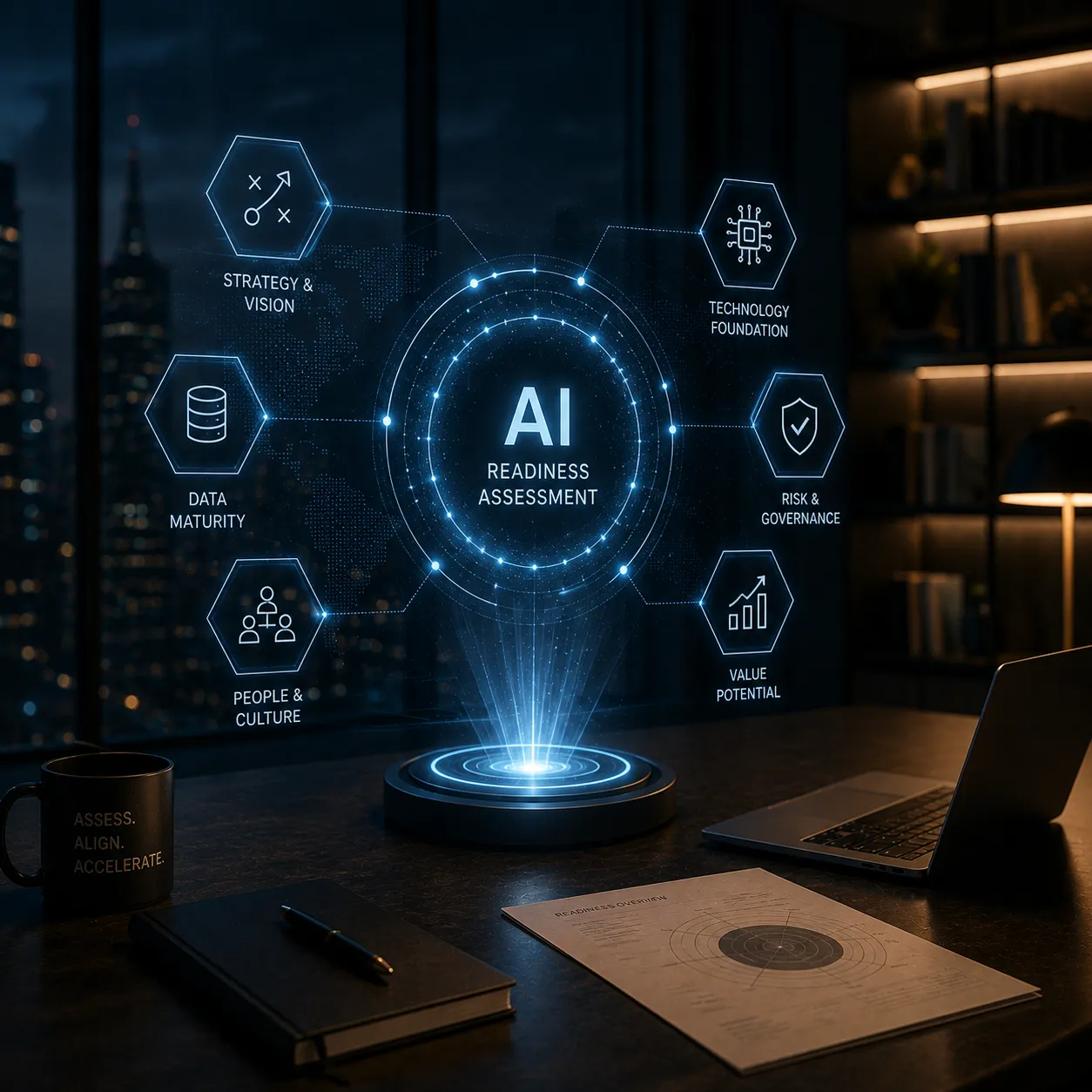
Most AI readiness assessments end the same way. Leadership gets a maturity score, a polished slide deck lands in a shared folder, and everyone leaves with the feeling that progress happened. Six months later, nothing has changed except the budget line. The problem is not measuring readiness. It's mistaking a diagnosis for a plan
What Is an AI Readiness Assessment?
An AI readiness assessment is a structured evaluation of an organization's preparedness to adopt and scale AI, typically measuring strategy alignment, data quality, infrastructure, talent, governance, and culture. The output should be a composite readiness score, a dimension-by-dimension gap analysis, and a phased implementation roadmap that turns identified gaps into funded, scheduled work.
AI readiness assessments come in four forms:
| Type | What it involves | Typical cost | Best when |
|---|---|---|---|
| Free self-assessment tools (Microsoft, Cisco, TDWI) | Online questionnaire, automated score, general recommendations | Free | You need a directional benchmark in 15 minutes before deciding whether to invest further |
| Consulting engagement (the companies on this list) | Expert-led evaluation, stakeholder interviews, data audit, custom roadmap | $15,000 to $300,000+ | You need an actionable roadmap tied to your specific data, infrastructure, and business goals |
| White-label platforms (Audity, Pointerpro, ISG) | Assessment software that consultants rebrand and use with their own clients | $500 to $5,000/month | You're a consultant building an AI assessment practice |
| Cloud-specific programs (AWS, Google AIR) | Cloud vendor assessment focused on their ecosystem | Free to $25,000 | You've already chosen AWS/Azure/GCP and want a migration-ready readiness evaluation |
The free tools are useful for a first conversation with leadership. They are not sufficient for preventing the 80% AI project failure rate that RAND Corporation research documents. That requires expert-led assessment connected to a realistic implementation plan.
Top 7 AI Readiness Assessment Companies in 2026
1. Octopus Builds
Best for: Organizations that need assessment directly connected to production AI implementation, not a score that sits in a slide deck.
Octopus Builds approaches AI readiness assessment as the first phase of a production-grade AI engagement, not a standalone deliverable. The same team that identifies the gaps builds the systems that close them.
Assessment dimensions:
- Data readiness (quality, availability, pipeline maturity)
- Infrastructure readiness (compute, security, integration points)
- Team readiness (skills, capacity, AI literacy)
- Governance readiness (compliance posture, data policies, model risk management)
- Use-case viability (which AI applications produce ROI given the organization's current state)
- Production-path feasibility (what it takes to move from pilot to operating environment, including security review, observability, and integration)
What the deliverable includes: Composite readiness score, dimension-by-dimension gap analysis, prioritized use-case portfolio with ROI projections, and a phased implementation roadmap with realistic timelines and budget. Initial scoping typically happens within 72 hours.
What separates Octopus Builds: The roadmap is written by the team that will execute it. AI agents, LLM-powered workflows, process automation, and ML infrastructure are designed and deployed by the same people who ran the assessment. No handoff to a different vendor. No diagnosis-to-build gap.
Pricing: $15,000 to $75,000 for the assessment phase, with implementation priced separately.
Schedule a call with Octopus Builds.
2. RSM
Best for: Mid-market companies that need a structured, time-boxed assessment with a clear deliverable.
RSM delivers AI readiness assessments as a defined 4-week consulting engagement:
- Week 1: Stakeholder interviews and current-state documentation
- Week 2-3: Data audit, infrastructure review, gap analysis
- Week 4: Final deliverable (maturity scorecard, prioritized use-case list, phased implementation roadmap)
Strength: Strong in mid-market financial services, manufacturing, and healthcare, where regulatory considerations add complexity. The assessment explicitly addresses compliance gaps (HIPAA, SOC 2, industry-specific regulations) alongside data and infrastructure.
Limitation: The 4-week fixed timeline works well for structured evaluation but may not be deep enough for organizations with highly complex, multi-division AI ambitions.
Pricing: $50,000 to $100,000 for the 4-week engagement.
3. Deloitte
Best for: Large enterprises that need assessment tied to board-level governance, regulatory compliance, and multi-year transformation planning.
Deloitte's AI readiness assessment uses its FAIR-based framework covering three tiers:
| Tier | What it evaluates |
|---|---|
| Foundational readiness | Data quality, infrastructure maturity, talent, and skills |
| Operational readiness | Processes, governance frameworks, and change management capacity |
| Strategic readiness | Business objective alignment, competitive positioning, and board-level oversight |
Strength: Scale and depth. Deloitte can deploy teams across multiple business units, geographies, and regulatory environments simultaneously. The assessment connects to their broader risk advisory and digital transformation practices.
Limitation: Enterprise-priced and typically 6 to 12 weeks. For organizations below $500 million in revenue, the engagement may be larger than the problem requires.
Pricing: $100,000 to $300,000+ for enterprise engagements. Shorter quickstart assessments available at lower price points.
4. Thoughtworks
Best for: Technology-led organizations that want assessment conducted by practitioners who build AI systems, not strategy consultants who advise on them.
Thoughtworks brings a software engineering perspective that consulting firms often lack. Their assessment evaluates whether the engineering practices, CI/CD pipelines, testing frameworks, and deployment patterns are ready to support AI in production.
Assessment dimensions unique to Thoughtworks:
- Data engineering maturity (pipeline reliability, monitoring, schema management, not just data quality)
- MLOps readiness (can the organization retrain, deploy, and monitor models in production?)
- Platform architecture (designed for AI workloads, or will it need rearchitecting?)
- Team capability (can engineers build, test, and maintain AI systems, or do they need upskilling?)
Strength: More technical and more actionable at the engineering level than strategy-firm assessments.
Limitation: Less emphasis on board-level governance and organizational change management than Deloitte or McKinsey.
Pricing: $40,000 to $150,000 depending on scope and duration.
5. Quantiphi
Best for: Organizations building on AWS that want an assessment from an AI-native firm with deep cloud-platform expertise.
Quantiphi is an AI-native consulting firm (not a traditional consultancy with an added AI practice) and an AWS Premier Partner. The readiness evaluation maps directly to AWS services:
| Readiness dimension | Maps to the AWS service |
|---|---|
| Model development | SageMaker |
| Foundation model access | Bedrock |
| Document processing | Textract |
| Computer vision | Rekognition |
| Data lake maturity | S3 + Glue + Lake Formation |
Strength: Assessment informed by hands-on AI implementation experience from AI researchers and ML engineers, not purely advisory knowledge. Some AWS-co-funded programs reduce the assessment cost.
Limitation: Platform-specific. If the organization hasn't committed to AWS or operates multi-cloud, the assessment will lean toward AWS solutions.
Pricing: $30,000 to $100,000 for assessment engagements.
6. Avanade
Best for: Microsoft-centric enterprises that need assessment aligned with Azure AI, Copilot, and the broader Microsoft ecosystem.
Avanade (the Accenture-Microsoft joint venture) evaluates readiness through Microsoft's 7-pillar AI framework:
- Business Strategy
- AI Governance and Security
- Data Foundations
- AI Strategy and Experience
- Organization and Culture
- Infrastructure for AI
- Model Management
Strength: The deepest Microsoft ecosystem expertise on this list. The deliverable includes a maturity score benchmarked against Avanade's client base and an implementation roadmap mapping directly to Azure services and Microsoft licensing.
Limitation: Microsoft-ecosystem-specific. Organizations running multi-cloud or non-Microsoft infrastructure will find recommendations less applicable.
Pricing: $50,000 to $150,000. Some Microsoft-co-funded programs available.
7. McKinsey & Company
Best for: Board-level and C-suite audiences that need the assessment to serve as both a diagnostic tool and a strategic mandate for enterprise-wide AI transformation.
McKinsey's AI readiness work draws from its "Rewired" framework, positioning AI adoption as an enterprise transformation. The assessment covers:
- Strategic clarity: Does leadership agree on why AI matters and where it fits?
- Operating model: Is the organization structured to build, deploy, and govern AI?
- Talent: Does the organization have or can it attract the necessary skills?
- Data architecture: Is data accessible, governed, and AI-ready?
- Technology infrastructure: Can the current stack support AI workloads?
Strength: Influence. A McKinsey assessment carries weight with boards, investors, and regulators. The "Rewired" framework has become a reference standard in enterprise AI strategy.
Limitation: Typically part of larger strategic engagements. McKinsey identifies what needs to change; implementation is usually handed to a different firm or internal team. The assessment-to-implementation gap is widest here.
Pricing: $200,000 to $500,000+ as part of broader strategic engagements.
Quick Comparison: All 7 Companies at a Glance
| Company | Best for | Assessment duration | Pricing | Builds what they recommend? |
|---|---|---|---|---|
| Octopus Builds | Assessment-to-production, one team | 3 to 12 weeks | $15K to $75K | Yes, the same team assesses and implements |
| RSM | Mid-market, time-boxed, regulated industries | 4 weeks (fixed) | $50K to $100K | Partial (advisory + roadmap, implementation separate) |
| Deloitte | Enterprise governance, multi-division, regulatory | 6 to 12 weeks | $100K to $300K+ | Partial (connects to Deloitte implementation teams) |
| Thoughtworks | Engineering-depth, MLOps readiness, practitioner-led | 4 to 8 weeks | $40K to $150K | Yes, builds software and AI systems |
| Quantiphi | AWS-committed, AI-native expertise | 3 to 6 weeks | $30K to $100K | Yes, implements on AWS |
| Avanade | Microsoft/Azure ecosystem | 4 to 8 weeks | $50K to $150K | Partial (connects to Accenture/Microsoft delivery) |
| McKinsey | Board-level mandate, strategic transformation | 6 to 12+ weeks | $200K to $500K+ | No (strategy only, implementation handed off) |
Ready to Assess Your AI Readiness?
Octopus Builds runs AI readiness assessments that connect directly to production implementation. The same team that evaluates your data, infrastructure, governance, and use-case portfolio designs and deploys the AI agents, automation workflows, and LLM-powered systems that the assessment recommends. No handoff to a different vendor. No slide deck that sits in a shared drive. Assessment to production, one team.
Build with Octopus Builds
Need help turning the article into an actual system?
We design the operating model, product surface, and delivery plan behind AI systems that need to ship cleanly and keep working in production.