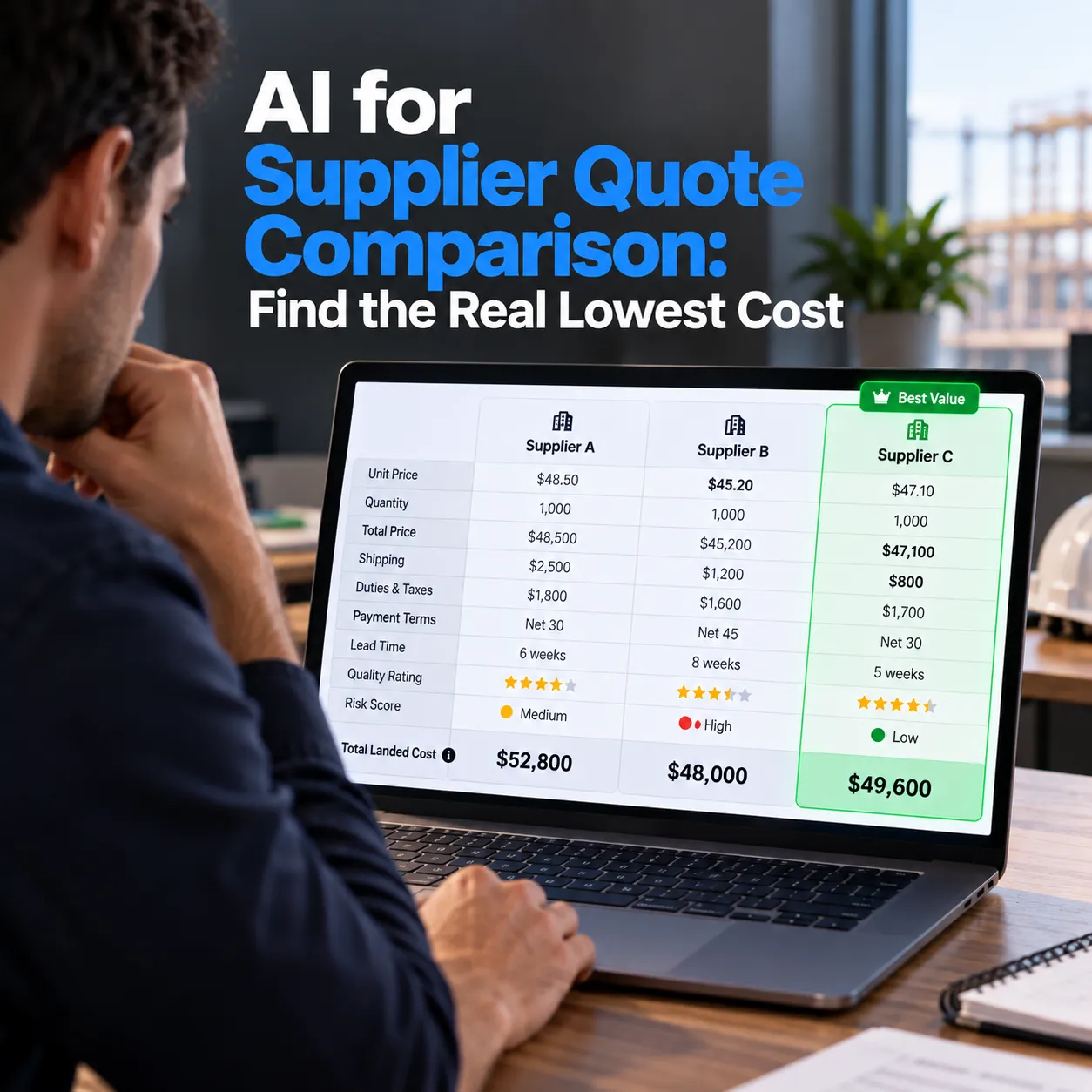
Three supplier quotes land for the same part, but one EXW quote wins on unit price while being the most expensive overall once freight, duties, tooling, and inventory are accounted for. This is the core problem AI for supplier quote comparison solves.
What Is Supplier Quote Comparison?
Supplier quote comparison is the process of evaluating quotations from multiple suppliers on a common basis so a buyer can identify the best total value, not just the lowest unit price. It is sometimes called quote normalization or quote leveling.
A proper comparison puts every quote on the same:
- Quantity: priced at your real order volume, not each supplier's preferred price break
- Delivery basis: one Incoterm and one destination
- Cost scope: tooling, packaging, testing, and certification either included everywhere or added everywhere
- Time horizon: lead time and payment terms converted into cost where they differ
Without that normalization, a comparison sheet ranks quotes that describe different deals.
Why Supplier Quotes Are So Hard to Compare
| Dimension | How quotes differ | What it hides |
|---|---|---|
| Incoterms | EXW, FOB, and DDP quotes side by side | Freight, insurance, and duties shift between buyer and supplier |
| Price breaks and MOQ | Each supplier prices at a different quantity tier | A low unit price that requires buying far more than you need |
| Tooling and NRE | Included in one quote, billed separately in another | A $20,000 tool adds $2.00 per unit over 10,000 units, $0.20 over 100,000 |
| Exclusions | Packaging, labeling, testing, or certification left out | Costs that appear later as change orders or surprise invoices |
| Lead time | 2 weeks vs 8 weeks | Safety stock, expedited freight, and stockout risk |
| Payment terms | Net 60 vs 50% upfront | Working capital tied up before goods arrive |
| Units and currency | Per piece vs per box, USD vs EUR vs CNY | Silent math errors in the comparison sheet |
| Quote validity | Some quotes expire in 7 days, others in 90 | Awarding against a price that no longer exists |
Every one of these can flip which supplier is cheapest. Most comparison sheets capture two or three of them.
Why Manual Quote Comparison Breaks Down
The difficulty isn't the math. It's everything around it:
- Quotes arrive through every channel: email bodies, PDF attachments, spreadsheets, supplier portals, phone calls, and messaging apps, so collection often takes longer than analysis
- Every quote gets re-keyed by hand: each re-typed line is a chance for a unit or decimal error
- Normalization gets skipped under deadline: freight and tooling adjustments are the first thing dropped when a PO has to go out today
- Past pricing isn't at hand: buyers can't easily check whether this quarter's price is 20% above the same supplier's last quote
- Teams default to familiar suppliers: when a thorough comparison takes hours, buyers pick the supplier they already know instead of the best value
What AI Automates in Supplier Quote Comparison
Collecting quotes from every channel
AI monitors the inboxes and portals where quotes arrive, matches each response to the right RFQ and line item, and tracks which suppliers haven't replied yet. Nobody has to chase attachments across threads.
Extracting line items from any format
AI reads PDFs, scanned documents, spreadsheets, and plain email text, then pulls out unit prices, price breaks, MOQ, tooling, lead time, payment terms, Incoterms, validity dates, and stated exclusions into one structured record per quote.
Normalizing every quote to a common basis
Quotes are converted to your order quantity, your delivery Incoterm and destination, your unit of measure, and your currency. Tooling is amortized over your expected program volume, not the first order.
Calculating total landed cost
Freight, duties, insurance, and handling are added using your lane data and rates, so every supplier is compared on the cost to get the part to your dock.
Flagging exclusions, deviations, and expired quotes
AI reads the fine print: excluded testing, alternate materials, a different revision, a quote that expires before your approval cycle finishes. Each gets flagged next to the price it affects.
Comparing against history
Each quote is checked against past quotes and purchase prices for the same or similar items. Outliers surface automatically, which gives buyers data for negotiation instead of instinct.
Weighted supplier scoring
Price is combined with lead time, quality history, on-time delivery, and certifications such as ISO 9001, weighted the way your category requires. A medical device buyer weights compliance heavily. A fast-turn buyer weights lead time.
Example: When the Cheapest Quote Costs the Most
Illustrative figures for a 2,000-unit order on a program expected to run 10,000 units:
| Supplier A | Supplier B | Supplier C | |
|---|---|---|---|
| Unit price | $4.20 | $4.60 | $5.10 |
| Incoterm | EXW | FOB | DDP |
| Freight and duties per unit | $1.10 | $0.80 | Included |
| Tooling | $6,000 separate ($0.60/unit over 10,000) | Included | Included |
| Lead time | 8 weeks | 6 weeks | 3 weeks |
| Landed cost per unit | $5.90 | $5.40 | $5.10 |
Ranked by unit price, Supplier A wins. Ranked by landed cost, it finishes last, before accounting for the extra safety stock an 8-week lead time requires. A comparison system surfaces this on every RFQ, not just the ones a buyer has time to work through by hand.
Where Buyers Still Make the Call
AI prepares the comparison. The award decision stays with people who know things the data doesn't:
- Supplier risk and relationships: financial stability, geopolitical exposure, and a supplier's history of honoring commitments
- Dual-sourcing strategy: sometimes the second-cheapest supplier wins a share of volume to protect supply
- Spec deviations: a proposed alternate material needs engineering or quality approval, not a pricing decision
- Negotiation: the comparison shows where to push; the buyer decides how hard and on what
- Final award: someone accountable approves the PO, with the normalized comparison recorded as the reason
Signs Your Team Needs Automated Quote Comparison
If three or more of these sound familiar, manual comparison is already costing you margin:
- Buyers spend more time collecting and re-typing quotes than evaluating them
- Comparison sheets rank suppliers by unit price only
- Freight, duties, and tooling get estimated after the award, not before
- POs have gone out against expired quotes
- Nobody can quickly answer what you paid for the same part last year
- Awards go to incumbent suppliers because a full comparison takes too long
- Landed cost surprises show up in variance reports every quarter
What a Quote Comparison Engagement With Octopus Builds Looks Like
Every procurement team compares quotes differently, so the system is built around your categories, your cost rules, and your ERP.
| Phase | What happens | What you get |
|---|---|---|
| 1. Workflow audit | We trace how quotes arrive, where they get re-keyed, and where decisions stall | A clear map of where time and margin leak |
| 2. Cost rules | We document your Incoterm basis, freight lanes, duty rates, tooling amortization, and scoring weights | Your comparison logic, written down and testable |
| 3. Intake and extraction | Quotes from email, PDFs, and portals are captured and structured automatically | No more manual re-typing |
| 4. Normalization and landed cost | Every quote is converted to a common basis with landed cost calculated | Comparisons your buyers can trust |
| 5. History and scoring | Past pricing and supplier performance feed into each comparison | Negotiation data on every RFQ |
| 6. ERP and approval | The approved award flows into your ERP as a purchase order, with the comparison attached | A clean audit trail from quote to PO |
Scoping takes about two weeks, and working software ships every two weeks after that, so buyers use the system on live RFQs early.
Stop Awarding on Unit Price Alone
The cheapest quote on a spreadsheet and the lowest-cost supplier are often different companies. The difference is freight, tooling, MOQ, lead time, and payment terms, which most comparison sheets don't capture consistently because there isn't time.
Octopus Builds builds supplier quote comparison systems that collect quotes from every channel, normalize them to your cost rules, calculate landed cost, and route the award to your buyers for the final call.
If your team is still comparing supplier quotes by hand and hoping the lowest unit price is the right choice, schedule a call with Octopus Builds.
Build with Octopus Builds
Need help turning the article into an actual system?
We design the operating model, product surface, and delivery plan behind AI systems that need to ship cleanly and keep working in production.