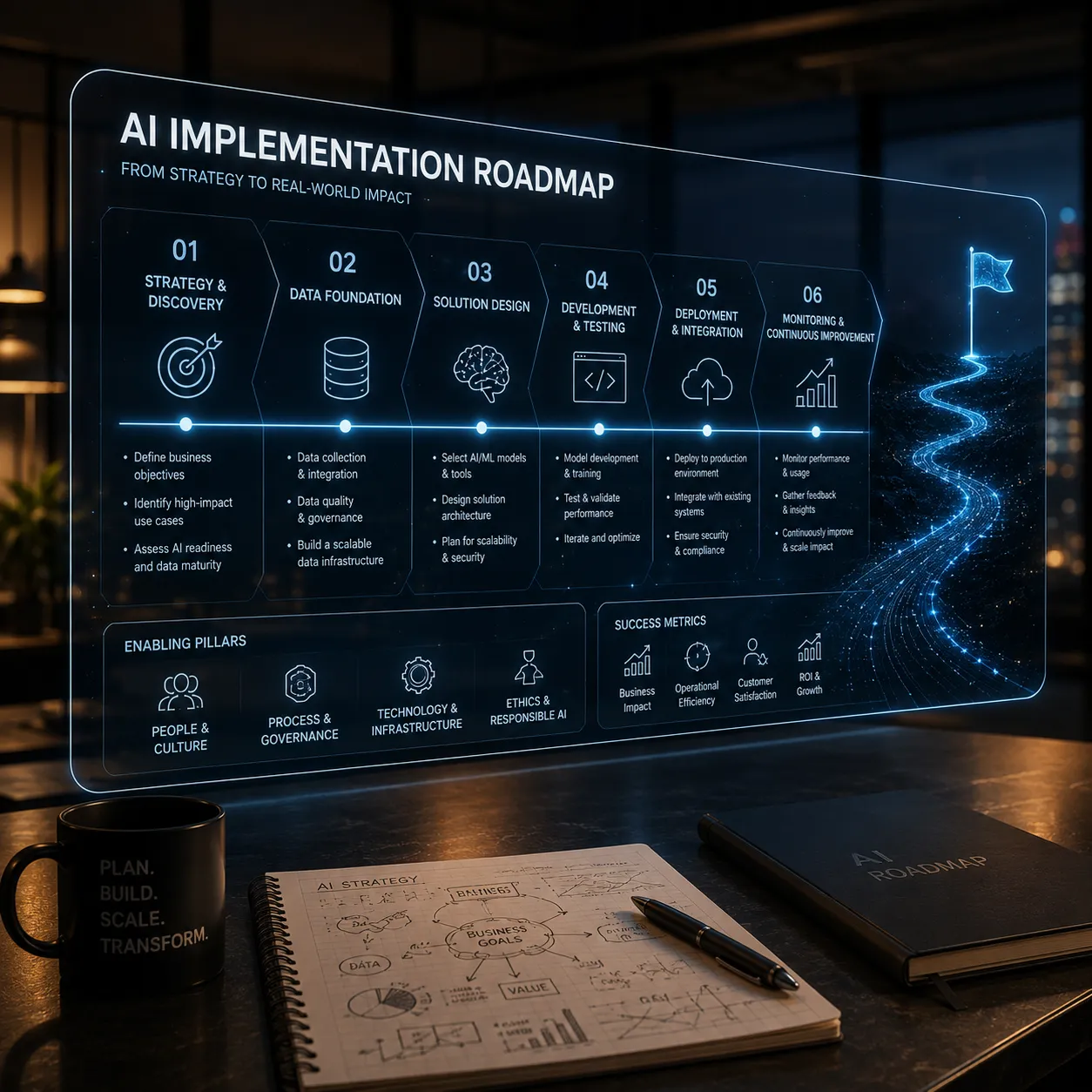
In 2025, enterprises invested over $684 billion in AI, yet most initiatives failed to create meaningful business value. Studies from RAND, MIT Sloan, S&P Global, and Gartner point to a clear pattern: the problem is rarely the technology itself. Organizations with structured AI implementation roadmaps achieve 3 to 5 times higher success rates than those taking an ad hoc approach. This guide shows how to build that roadmap.
What Is an AI Implementation Roadmap?
An AI implementation roadmap is a phased, time-bound plan that guides an organization from initial readiness assessment through pilot, production deployment, governance, and scaling. It is not the same thing as an AI strategy, an innovation agenda, or an IT project plan.
The distinctions matter because conflating them is one of the most common reasons AI programs lose executive sponsorship:
| Term | What it answers | Scope |
|---|---|---|
| AI strategy | What and why: which business problems AI will solve, and what competitive advantage it creates | The thesis |
| AI implementation roadmap | How and when: which phases, what deliverables, what timeline, what budget, what go/no-go gates | The plan that turns the strategy into working systems |
| IT project plan | Who does what this sprint: tasks, assignments, dependencies for one specific build | A downstream artifact inside Phase 3 or Phase 4 of the roadmap |
Most organizations that fail at AI have a strategy (or at least a slide deck). Most do not have a roadmap. The difference between the two is the difference between knowing where you want to go and having a route that gets you there.
Why 80% of AI Projects Fail: The 5 Root Causes.
Eighty percent of AI projects fail to deliver intended business value according to RAND Corporation research, and the primary cause is not technology failure but process failure. The failure landscape across RAND, MIT Sloan, McKinsey, Gartner, S&P Global, and Deloitte converges on five root causes. What makes these useful rather than just alarming is that each maps to a specific roadmap phase that prevents it.
| Root cause | Scale of the problem | Which roadmap phase prevents it |
|---|---|---|
| Data unreadiness | Gartner predicts 60% of AI projects will be cancelled due to inadequate data foundations by the end of 2026 | Phase 1: Readiness Assessment — audit data quality, availability, and pipeline readiness before selecting a use case |
| No clear success metrics | 73% of failed AI projects had no pre-defined success criteria | Phase 2: Strategy — define measurable outcomes and go/no-go gates before any build starts |
| Lost executive sponsorship | 56% of failed initiatives lost C-suite engagement mid-project; 84% of failures are leadership-driven | Phase 2: Strategy — secure executive commitment with a defined business case, not just a technology pitch |
| Pilot purgatory | 30% of GenAI projects are abandoned after POC (Gartner); 95% of GenAI pilots fail to reach measurable P&L impact (MIT Sloan) | Phase 4: Production Deployment — build MLOps, integration, and change management into the plan from day one |
| Change management gap | Organizations investing in cultural change see 5.3x higher success rates (McKinsey), yet most budgets allocate less than 5% to adoption | Phase 5 + 6: Governance and Scaling — treat organizational adoption as a budget line, not a slide in the deck |
The median abandoned AI project runs 11 months and costs $4.2 million in sunk investment before being scrapped (Deloitte). That cost isn't the technology. It's the opportunity cost of an organization that spent a year building the wrong thing, learning nothing from it, and losing confidence in AI investment altogether.
The 6-Phase AI Implementation Roadmap
The six phases of AI implementation are readiness assessment, strategy and use-case prioritization, pilot development, production deployment and MLOps, governance and risk management, and scaling and continuous optimization. Each phase ends with a named deliverable and a go/no-go gate before advancing to the next.
Phase 1: AI Readiness Assessment (4 to 6 Weeks)
A readiness assessment (sometimes called an AI maturity assessment) evaluates whether the organization has the foundation to support AI implementation. This is the phase most organizations skip, and the phase whose absence causes the most expensive failures.
Four dimensions to assess:
Data readiness. Do the datasets required for the target use cases exist? Are they accessible? Are they clean enough to produce reliable outputs, and do you have the pipelines to keep them current? If the answer to any of these is "not yet," Phase 1 should produce a data remediation plan with a timeline and a budget, not a vague commitment to "fix the data."
Infrastructure readiness. Does the organization have compute capacity (cloud or on-premise), data storage and retrieval systems, CI/CD pipelines, and the security infrastructure to support AI workloads? For most organizations in 2026, this is less about whether capacity exists and more about whether governance, security, and integration are ready for it.
Talent readiness. Does the team include data scientists, ML engineers, or AI-literate product managers? The minimum viable AI team for a 500-person company is typically 2 to 4 people: a senior ML engineer or data scientist, an AI product manager, and one or two AI-literate engineers who can handle integration.
Cultural readiness. Is there executive sponsorship with staying power? Do frontline teams see AI as a capability or a threat? The 5.3x success-rate multiplier for cultural investment means this dimension deserves budget, not just a section in the kickoff deck.
Phase 1 deliverable: A readiness report with red/amber/green assessment across all four dimensions, a gap remediation plan, and a recommendation on whether to proceed, pause, or invest in foundational work first.
Phase 2: Strategy and Use-Case Prioritization (3 to 4 Weeks)
This phase turns the readiness assessment into a scoped plan. It identifies candidate use cases, prioritizes them, defines measurable success criteria, builds the business case, and secures executive sign-off.
Use-case prioritization method. A 2x2 matrix of business impact versus feasibility:
- Business impact: revenue uplift, cost reduction, risk reduction, or time saved
- Feasibility: data readiness, technical complexity, integration requirements, regulatory constraints
Score each candidate, rank them, and pick the top 1 or 2 for the pilot phase. Most failures at this stage come from organizations that try to pilot 5 or more use cases simultaneously.
Success criteria. Define them before the build starts. Projects with pre-defined metrics succeed at meaningfully higher rates. "Improve efficiency" is not a metric. "Reduce invoice processing time by 40% within 90 days of deployment" is a metric.
Phase 2 deliverable: A prioritized use-case portfolio, a business case with ROI projections, defined success criteria, a budget estimate, and documented executive sign-off.
Phase 3: Pilot Development and the Minimum Viable Model (8 to 12 Weeks)
This phase builds the first working version of the AI system. The goal is not production deployment. The goal is a minimum viable model (MVM): the smallest functional version that generates real feedback from real users against the success criteria defined in Phase 2.
The MVM will typically take one of two forms:
- Generative AI application (chatbot, copilot, content generator, agent) built on foundation model APIs like OpenAI, Anthropic Claude, or Google Gemini, orchestrated with LangChain or LlamaIndex
- Predictive ML model (demand forecasting, anomaly detection, classification) built with scikit-learn, PyTorch, or TensorFlow and served through AWS SageMaker, Google Vertex AI, or Databricks
In both cases, the pilot should produce measurable results against Phase 2 success criteria within the 8 to 12 week window. Two things matter more than model accuracy at this stage: integration with the systems users actually work in, and evaluation infrastructure that measures quality in a structured, repeatable way.
Phase 3 deliverable: A working MVM integrated into at least one user workflow, a structured eval framework with baseline metrics, and a go/no-go recommendation for production.
Phase 4: Production Deployment and MLOps (8 to 12 Weeks)
This is where most AI projects die. The pilot works, but the path to production was never planned.
Production deployment means the AI system is serving real users, in a real operating environment, with real data, under real compliance and security constraints. The requirements that distinguish production from pilot:
- Identity and access controls (SSO, role-based access, per-user data isolation)
- Observability and logging (structured evaluation, drift detection, audit trail)
- Error handling and fallback paths (what happens when the AI fails)
- Human-in-the-loop escalation (where regulation or risk demands it)
- Monitoring for model drift (automated alerts when performance degrades)
MLOps is the practice of keeping AI running reliably in production. The minimum viable MLOps stack includes an eval harness, automated retraining or re-prompting pipelines, and performance dashboards. Tools include MLflow, Weights and Biases, SageMaker Pipelines, Vertex AI Pipelines, LangSmith (for LLM applications), and Helicone.
Phase 4 deliverable: A production-deployed AI system with observability, monitoring, fallback paths, documented runbooks, and a maintenance plan.
Phase 5: Governance and Risk Management (Ongoing From Phase 1)
Governance is listed as Phase 5, not because it starts here, but because this is where it becomes a standalone workstream with its own deliverables. The best implementations integrate governance thinking from Phase 1 and formalize it in Phase 5 as the system reaches production.
The governance framework should cover four areas:
Regulatory compliance. The EU AI Act classifies AI systems by risk tier and imposes specific requirements for high-risk applications. NIST AI RMF (AI 100-1) provides a voluntary US framework for AI risk management. ISO 42001 establishes requirements for AI management systems and is increasingly requested in enterprise procurement.
Data governance. What data goes into the AI system, who has access, how long is it retained, and what happens when a user requests deletion? GDPR Article 22 specifically addresses automated decision-making with legal effects.
Model risk management. How is model quality monitored, who is accountable when the model produces a harmful or incorrect output, and what's the escalation and remediation path?
Responsible AI principles. Bias detection and mitigation, explainability, transparency, and accountability. These are no longer optional for enterprise deployment; they are procurement requirements for most large customers.
Phase 5 deliverable: A documented AI governance framework covering regulatory compliance, data governance, model risk management, and responsible AI principles, with named owners for each area.
Phase 6: Scaling and Continuous Optimization (6 to 18 Months)
Scaling moves the organization from one successful AI deployment to a portfolio of deployments across business functions. Most organizations never reach this phase because they stall in pilot purgatory or never formalize governance enough to get legal sign-off for wider deployment.
The organizations that reach Phase 6 successfully share three structural patterns:
- A dedicated AI program office (or at minimum a named AI lead) coordinating across business units
- A standardized evaluation and deployment pipeline through which new use cases can flow without reinventing the infrastructure
- Change management as an explicit, funded workstream, not a line in someone's quarterly objectives
McKinsey's data on AI high performers is instructive: organizations where more than 5% of EBIT is attributable to AI are 3.6 times more likely to be pursuing transformational, enterprise-level change rather than incremental, function-by-function improvement. Scaling AI is an organizational transformation, not a technology rollout.
Phase 6 deliverable: A multi-use-case AI portfolio with shared infrastructure, a pipeline for identifying and prioritizing new use cases, a change management program, and quarterly ROI measurement.
How Long Does AI Implementation Take?
A typical enterprise AI implementation spans 12 to 24 months across all six phases. Focused initiatives in smaller organizations can deliver initial ROI in 6 to 12 months.
| Phase | SMB (50-500 people) | Mid-market (500-5,000) | Enterprise (5,000+) |
|---|---|---|---|
| Phase 1: Readiness Assessment | 2 to 3 weeks | 4 to 6 weeks | 6 to 8 weeks |
| Phase 2: Strategy and Prioritization | 2 to 3 weeks | 3 to 4 weeks | 4 to 6 weeks |
| Phase 3: Pilot Development | 6 to 8 weeks | 8 to 12 weeks | 10 to 16 weeks |
| Phase 4: Production Deployment | 4 to 8 weeks | 8 to 12 weeks | 12 to 20 weeks |
| Phase 5: Governance | Ongoing (lighter) | Ongoing (formal) | Ongoing (structured program) |
| Phase 6: Scaling | 3 to 6 months | 6 to 12 months | 12 to 18 months |
| Total to first production deployment | 3 to 5 months | 6 to 9 months | 9 to 14 months |
| Total through scaling | 6 to 12 months | 12 to 18 months | 18 to 24+ months |
The timeline compresses significantly when the organization partners with a delivery team that has already built the infrastructure patterns. The production deployment phase (Phase 4) benefits most from external expertise because it's the phase with the most predictable and preventable failure modes.
How Much Does AI Implementation Cost?
Budget ranges for AI implementation vary by company size, use-case complexity, and whether the build is internal, consultant-led, or partner-delivered. The ranges below cover first-year costs from readiness assessment through initial production deployment.
| Company size | First-year budget range | Allocation breakdown |
|---|---|---|
| SMB (50-500 people) | $50,000 to $250,000 | Talent: 40-50% / Cloud and infra: 25-30% / Tooling: 15-20% / Change management: 10-15% |
| Mid-market (500-5,000) | $250,000 to $1,500,000 | Talent: 50-60% / Cloud and infra: 20-25% / Tooling: 10-15% / Change management: 10-15% |
| Enterprise (5,000+) | $1,000,000 to $10,000,000+ | Talent: 50-60% / Cloud and infra: 15-20% / Tooling: 10-15% / Change mgmt: 10-15% / Governance: 5-10% |
Two budget lines most organizations get wrong:
Change management is chronically underfunded. Organizations that invest in cultural change alongside AI implementation achieve 5.3 times higher success rates, yet most AI budgets allocate less than 5% to organizational adoption. Treating change management as a budget line rather than a cultural wish is the single highest-ROI intervention in most roadmaps.
Ongoing operations are overlooked entirely. For every dollar spent on initial AI implementation, plan for roughly $0.70 to $1.20 in annual maintenance, monitoring, model updates, and infrastructure costs. AI systems are not one-time builds. They degrade without active maintenance.
How to Escape Pilot Purgatory: From POC to Production
Pilot purgatory is the state where an AI proof of concept works in isolation but never reaches production deployment. It is the single most common failure mode in enterprise AI.
The pattern is consistent across the failure analyses:
- The pilot was scoped as a technology experiment, not as a precursor to production
- It ran on synthetic data or a subset of production data without real integrations
- Identity, permissions, observability, and governance were classified as "Phase 2 problems."
- When "later" arrived, retrofitting those requirements exceeded the value the pilot had demonstrated
- The project was killed
Three structural interventions that prevent it:
1. Build the production path into the pilot scope. Phase 3 should include at least lightweight versions of integration, observability, and governance. A pilot that works only in a sandbox produces fundamentally different evidence than one that works in (or adjacent to) the production environment.
2. Define go/no-go criteria in Phase 2, not Phase 4. Before the pilot starts, the team should know exactly what outcome constitutes "move to production," what constitutes "iterate and re-test," and what constitutes "kill this use case and move to the next one."
3. Assign production ownership before the pilot starts. The team that builds the pilot is rarely the team that runs it in production. If the handoff is undefined, the pilot lives in the builder's backlog until someone kills it. Assign an operations owner in Phase 2 and involve them in the pilot review.
How to Measure AI ROI
AI ROI measurement needs to cover three dimensions because a single metric misses how AI creates value across an organization.
Financial metrics:
- Revenue generated or influenced by AI systems
- Cost reduction from automated processes
- Cost avoidance (errors prevented, compliance violations caught)
- Full cost of implementation, operation, and maintenance is included in the denominator
Operational metrics:
- Cycle time reduction (processing time, decision time, time to resolution)
- Throughput increase (volume of transactions, tickets, or decisions handled)
- Accuracy improvement (error rate, precision, recall)
- Customer experience metrics (NPS, CSAT, first-response time)
Strategic metrics:
- New capabilities enabled (products, services, or markets that weren't possible without AI)
- Competitive positioning changes
- Employee experience metrics (satisfaction, retention of AI-skilled talent)
The measurement framework should be defined in Phase 2 and baselined before the pilot starts. Post-hoc ROI calculation is unreliable because it's impossible to control for confounding variables after the system is live.
Ready to Build Your AI Implementation Roadmap?
If your organization is building an AI implementation roadmap, stuck in pilot purgatory with a POC that hasn't reached production, or planning the move from first deployment to enterprise-wide scaling, we design, deploy, and operate production-grade AI systems for teams that need the roadmap and the build, and we're honest about which phases your team can handle internally and where external delivery compresses the timeline.
Build with Octopus Builds
Need help turning the article into an actual system?
We design the operating model, product surface, and delivery plan behind AI systems that need to ship cleanly and keep working in production.