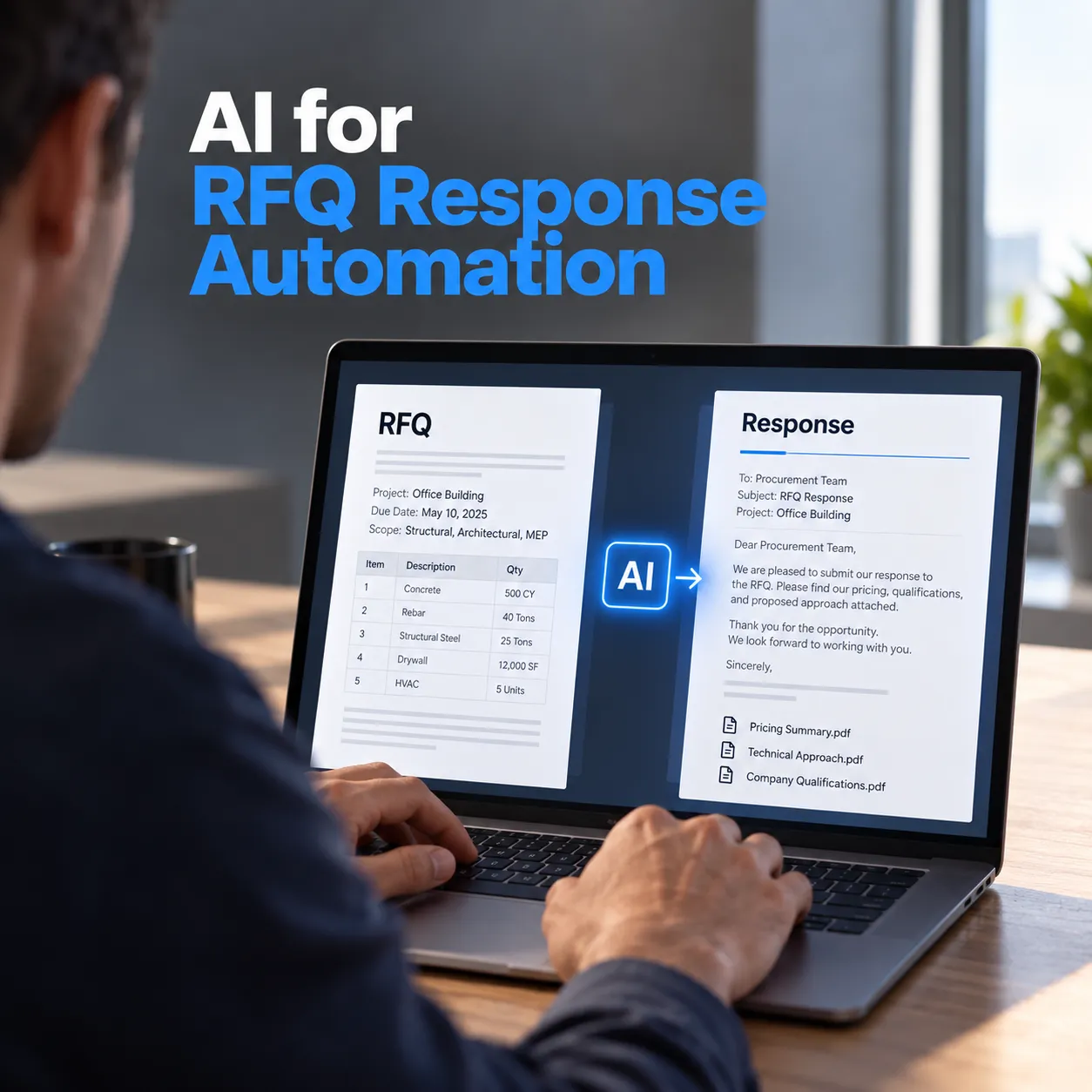
A general contractor needs pricing on 200 SKUs of electrical components for a bid due Friday. They send the RFQ to three distributors on Monday morning. One responds Monday afternoon. The other two are still routing the request internally by Wednesday. By the time the slower two send anything, the GC has already built their bid around the distributor who answered first.
Why Manual RFQ Response Is Structurally Too Slow
Most B2B organizations, whether distributors, manufacturers, or service providers, run RFQ response through the same fragmented sequence, and each step adds delay that compounds by the time a quote actually goes out.
| Bottleneck | What actually happens |
|---|---|
| Tight deadlines | Requests routinely carry 24 to 48 hour windows, leaving minimal room for pricing approvals or cross-team input |
| Manual routing | Someone has to read the request, figure out which team it belongs to, and forward it before real work begins |
| Scattered systems | Requirements pull from an ERP, a pricing spreadsheet, a shared drive, and sometimes a colleague who has to be pinged directly |
| Blanket approval chains | Routine, well-within-policy quotes wait on sign-off as if they were exceptions |
| Volume overload | A team fielding 10 inbound RFQs a day can lose 2.5 to 4 hours of manual processing before a single quote is written |
The realistic result across manual workflows: five to nine business days from request to sent quote is common in mid-market distribution and service businesses. Anything over a week is a clear competitive disadvantage. Five working days is merely competitive. Sub-two-day turnaround is where leading teams operate, and it's consistently where automated response workflows land once they're live.
RFQ Response Time Benchmarks: What "Fast" Means
| Time to quote | What it signals |
|---|---|
| Over 1 week | Competitive disadvantage: buyers have likely already engaged a faster competitor |
| 5 working days | Competitive, but not differentiated |
| Under 2 days | Leading performance, typical of automated workflows once live |
| Under 1 hour | Rare, but produces the strongest qualification and close rates |
The trend matters more than any single number. A time-to-quote that keeps improving month over month, with a stable error rate, is the real signal that a response process is working, not just one fast quote that happened to get lucky staffing that day.
What AI Automates in RFQ Response
Multi-Channel Intake and Classification
AI captures inbound requests regardless of channel, email, portal submission, or an attached document, and automatically classifies what product line, team, or urgency tier the request belongs to, removing the manual routing step that currently delays everything downstream.
Requirement Extraction From Unstructured Requests
RFQs rarely arrive as clean structured data. AI reads free-text requests, attached spec sheets, and SKU lists to extract the specific items, quantities, and requirements needed to build a response, instead of a person manually re-typing that information into a quoting tool.
Real-Time Pricing and Inventory Lookup
Connected directly to the ERP and pricing system, AI pulls current cost and availability data at the moment of response, removing the risk of a quote going out with yesterday's pricing on today's materials.
Draft Response Generation
AI assembles a first-pass quote or proposal response, populated with the extracted requirements, current pricing, and standard terms, ready for a human to review rather than build from a blank template under deadline pressure.
Approval Routing Based on Actual Risk, Not Blanket Policy
Requests within standard pricing and margin thresholds get routed for fast, often automatic approval. Genuinely non-standard requests, unusual discounts, or large deal sizes get escalated to the right person instead of every quote waiting in the same queue regardless of complexity.
Delivery and Follow-Up Tracking
Once approved, the response goes out through the same channel it arrived on, logged automatically, with follow-up sequences triggered if a quote goes unanswered past a set window.
Where Human Judgment Still Belongs in the Loop
Automating the mechanical steps doesn't remove the need for people to make the decisions that carry real risk:
- Non-standard pricing and margin exceptions: any request outside normal thresholds should route to a person, not get auto-approved by default
- Ambiguous or incomplete requirements: if the extracted request doesn't clearly specify what's needed, someone has to follow up with the buyer before a quote goes out, not guess and hope
- Strategic account handling: a request from a high-value or sensitive account may warrant a different response approach than the standard automated path, regardless of how routine the request looks on paper
- Final review before send: a human confirms the draft response reflects the actual request correctly before it reaches the buyer, catching what automated extraction might have missed
The goal of automation here isn't removing people from RFQ response: it's removing the hours of manual assembly work that currently stand between a request landing and a person making the judgment calls that matter.
Off-the-Shelf RFQ Response Tools vs a Custom-Built System
Several categories of existing tools already solve part of this problem well, depending on what your business actually sells.
| Tool category | Examples | Best fit |
|---|---|---|
| Response management platforms | Loopio | Teams handling formal RFPs and RFQs at volume, assembling responses from a searchable content library instead of a blank document |
| CPQ (configure-price-quote) platforms | Salesforce CPQ, Vendavo, PROS | Businesses with a structured catalog and consistent pricing rules |
| Manufacturing-specific quoting platforms | Paperless Parts | The CAD-to-quote workflow for machined and fabricated parts, a narrower but deeper use case |
Off-the-shelf tools work well when:
- Your product catalog and pricing structure are relatively standardized
- Your CRM and ERP are common enough that pre-built integrations exist
- Most of your RFQ volume is repeat or catalog business, not highly custom requests
A custom-built system is the right call when:
- Your pricing logic or approval structure is specific enough that generic CPQ rules don't map cleanly onto it
- You need the response workflow to write directly into a proprietary ERP or CRM without manual re-entry
- A meaningful share of your RFQs involve non-standard configurations that off-the-shelf tools handle poorly
- You've tried a generic platform and it underperformed specifically on your request mix
Most mid-market distributors and manufacturers end up with a hybrid: an off-the-shelf platform for standard catalog requests, and custom logic layered on top, or built separately, for the RFQs that don't fit a template.
How to Roll Out RFQ Response Automation Without Disrupting Sales
- Start with a time audit, not a tool purchase: track how RFQs actually move through your team for two weeks, timing how long intake sits before routing, how long extraction takes, and how long approval takes. This tells you which step is the real bottleneck before you automate the wrong one
- Automate intake and extraction first: these are the steps with the least judgment involved and the most wasted manual time, making them the fastest path to a measurable time-to-quote improvement
- Set approval thresholds before automating approval routing: define what counts as standard pricing versus an exception that needs a person, so the system routes correctly from day one instead of escalating everything out of caution
- Pilot on one product line or region before rolling out fully: measure time-to-quote and error rate on the pilot before expanding, so problems surface on a small, recoverable scale rather than across your entire sales team at once
- Track the trend, not a single fast quote: a steadily improving time-to-quote with a stable error rate is the real signal the system is working long-term
Why Response Speed Compounds Into Long-Term Revenue
RFQ speed doesn't just close the specific deal that arrived today. It changes what future business looks like from the same buyer.
Buyer research consistently shows that inconsistent information and a lack of responsive, knowledgeable support are now leading reasons B2B buyers switch suppliers entirely, not just lose a single deal. Buyers now interact across an average of ten channels during a purchase and expect seamless movement between them. A supplier who responds fast and accurately on one channel, then goes silent or contradicts pricing on another, loses the relationship, not just the transaction.
This is why RFQ response speed functions as a growth lever, not just a sales-ops efficiency metric. Teams that consistently answer first and accurately become the default vendor buyers route future requests to without even shopping around, compounding the value of the initial speed advantage well beyond the deal it originally won.
Common Mistakes That Undermine RFQ Response Automation
| Mistake | Why it backfires |
|---|---|
| Automating the draft but leaving approval bottlenecked | Every quote still waits in the same manual queue regardless of size or risk |
| Connecting to pricing data that isn't actually current | Produces fast, wrong quotes, which damages trust faster than a slow, correct one |
| Treating every RFQ the same regardless of complexity | High-volume standard and complex custom requests need different automation depth |
| Skipping the human check on ambiguous requests | Produces confidently wrong quotes that cost trust and margin |
| Buying a generic CPQ tool without checking pricing logic fit | Mismatched configuration rules create as much manual override work as they save |
Building an RFQ Response System Around Your Sales Process
Off-the-shelf quoting tools solve a real share of this problem for standardized, catalog-driven requests. Where they consistently fall short is for businesses with proprietary pricing logic, non-standard approval structures, or a need for the response workflow to write directly into an existing ERP and CRM instead of living in a separate, disconnected tool.
Octopus Builds designs RFQ response systems around your intake channels, your pricing data, and your approval structure, so the automation reflects how your team actually sells, not a generic template. Two-week scoping, working software delivered every two weeks, and human review built into the approval path from day one.
If your team is still losing deals to whoever answered first while your RFQ sits in a queue
Build with Octopus Builds
Need help turning the article into an actual system?
We design the operating model, product surface, and delivery plan behind AI systems that need to ship cleanly and keep working in production.