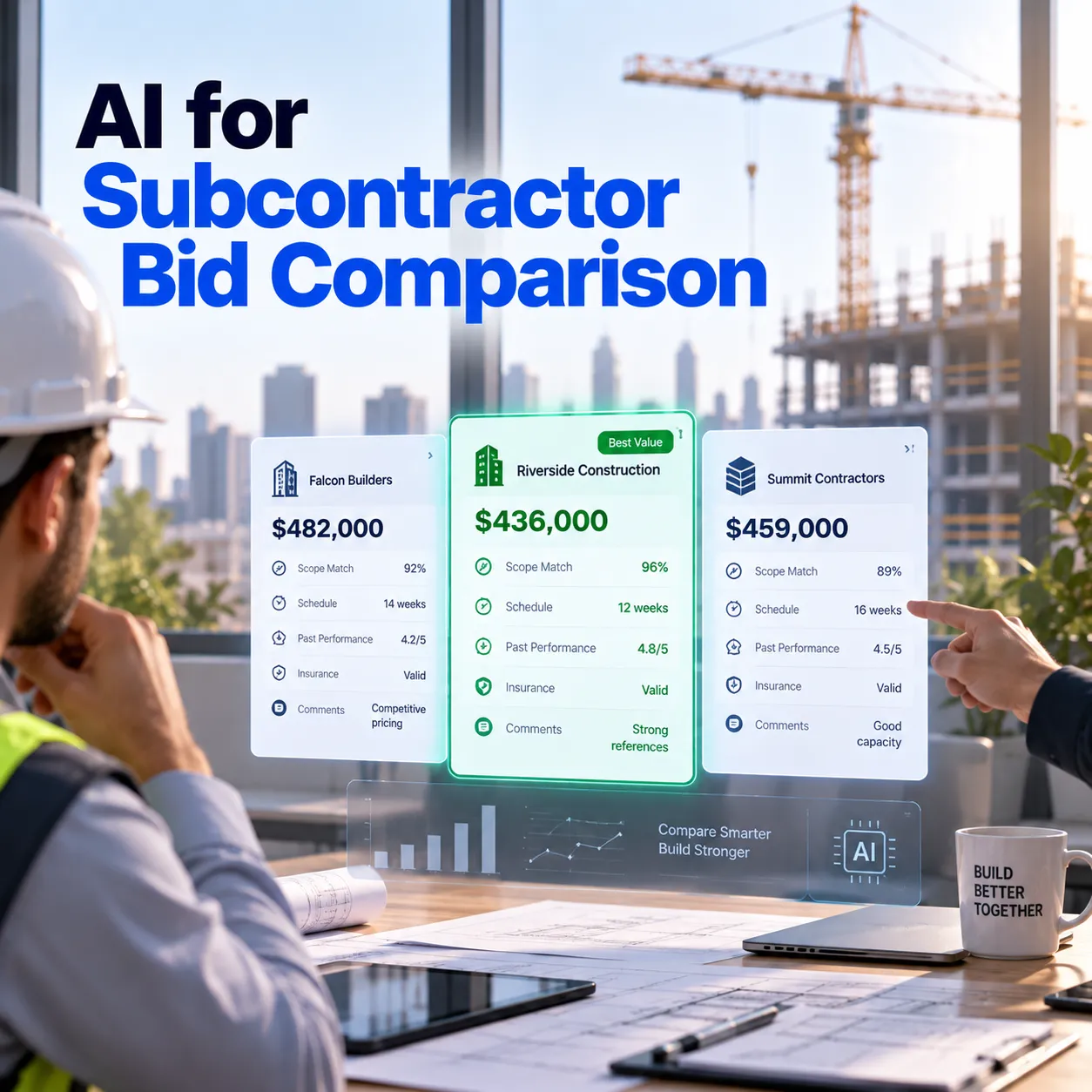
A general contractor sees a $200,000 price gap between bids, only to discover the low bidder excluded the vapor barrier while the mid-range bidder assumed it was covered. That $200K spread wasn't a pricing error but it was a scope gap that should have been caught earlier.
What Is Bid Leveling and How Is It Different From Bid Tabulation
Bid leveling is the process of normalizing competing subcontractor proposals to a common scope baseline, so a general contractor can make a true cost comparison that accounts for inclusions, exclusions, qualifications, and assumptions across every bid received. It's sometimes called bid normalization, though both terms describe the same underlying job.
Bid tabulation is a related but distinct term. Owners primarily use bid tabulation to evaluate bids from general contractors on a project. General contractors use bid leveling to analyze bids from specialty subcontractors within a single trade package.
Because a GC has to ensure the complete scope of work is covered for each trade, bid leveling tends to be the more complex process of the two, producing a more extensive comparison than a simple bid tab sheet.
The mechanics haven't changed in decades: each bidder gets a column, and each scope item, quantity, unit price, allowance, exclusion, and qualification gets its own row. What's changed is how much manual labor that grid requires as bid volume and project complexity increase.
Why Manual Bid Comparison Breaks Down Under Deadline Pressure
The spreadsheet-and-manual-review approach fails in a few specific, recurring ways.
Qualification Language Hides Scope Changes in Prose, Not Numbers
Nearly every subcontractor proposal has a section, often just two to five lines, that starts with "This proposal assumes..." or "Excludes...". That paragraph can functionally rewrite the scope the line-item numbers above appear to cover.
A bid that passes every line-item check can still conceal a meaningful share of scope inside a qualifier that a spreadsheet comparison alone will never surface, because qualifications don't announce themselves. They get buried in prose that has to be read closely, bid by bid, to catch.
Bid Formats Never Match Each Other
- One subcontractor submits a PDF
- Another sends a formatted Excel workbook
- A third emails a Word document with pricing embedded in a paragraph instead of a table
Before any real comparison can happen, someone has to manually extract and standardize data from formats that were never built to be compared against each other.
The Lowest Number Isn't Automatically the Best Bid
A subcontractor who bids low but can't realistically meet the schedule creates cost and risk that never shows up in the bid tab at all. Comparing purely on price, without accounting for exclusions, qualifications, and schedule realism, is how GCs end up awarding work to a bid that looks cheapest and turns out to be the most expensive once change orders start.
Volume Compounds Every One of These Problems
Leveling three bids manually is tedious but manageable. Leveling a dozen bids across multiple trade packages on a live project, each with its own formatting, qualification language, and scope quirks, turns a Wednesday afternoon task into a multi-day bottleneck that delays the entire award process.
Qualification Language Hides Scope Changes in Prose, Not Numbers
Qualification Language Hides Scope Changes in Prose, Not Numbers
Nearly every subcontractor proposal has a section, often just two to five lines, that starts with "This proposal assumes..." or "Excludes...". That paragraph can functionally rewrite the scope the line-item numbers above appear to cover.
A bid that passes every line-item check can still conceal a meaningful share of scope inside a qualifier that a spreadsheet comparison alone will never surface, because qualifications don't announce themselves. They get buried in prose that has to be read closely, bid by bid, to catch.
Bid Formats Never Match Each Other
- One subcontractor submits a PDF
- Another sends a formatted Excel workbook
- A third emails a Word document with pricing embedded in a paragraph instead of a table
Before any real comparison can happen, someone has to manually extract and standardize data from formats that were never built to be compared against each other.
The Lowest Number Isn't Automatically the Best Bid
A subcontractor who bids low but can't realistically meet the schedule creates cost and risk that never shows up in the bid tab at all. Comparing purely on price, without accounting for exclusions, qualifications, and schedule realism, is how GCs end up awarding work to a bid that looks cheapest and turns out to be the most expensive once change orders start.
Volume Compounds Every One of These Problems
Leveling three bids manually is tedious but manageable. Leveling a dozen bids across multiple trade packages on a live project, each with its own formatting, qualification language, and scope quirks, turns a Wednesday afternoon task into a multi-day bottleneck that delays the entire award process.
What AI Automates in Subcontractor Bid Comparison
| Component | What It Does | Where It Fails Without Care |
|---|---|---|
| Multi-format intake | Accepts bids as PDFs, scans, Excel, and Word documents. | Systems built for one format silently fail on the others. |
| Scope normalization | Maps differently worded line items to a common baseline. | Weak normalization produces a comparison that looks clean but hides real scope mismatches. |
| Qualification parsing | Reads exclusion and assumption language, not just numbers. | Tools that only extract line-item prices miss the exact risk qualification language is designed to carry. |
| Anomaly flagging | Surfaces pricing outliers and scope gaps against the spec. | Without this, a human still has to manually scan every bid to catch what should have been automatic. |
| Human review gate | A qualified estimator confirms flagged items before award. | Skipping this is how an AI-generated comparison, however good, can still result in a bad award decision. |
The qualification-parsing capability is where AI earns its keep most clearly: instead of a human scanning dense paragraphs of exclusion language across every bid under deadline pressure, AI catches what changes the effective price, schedule, or risk across all bids at once.
Where the GC's Judgment Still Has to Make the Call
AI comparison tools produce a cleaner, faster, more complete version of the bid tab. They don't make the award decision, and several factors that determine the right bid can't be reduced to a spreadsheet at all:
- Schedule realism: a low bid from a subcontractor who cannot realistically meet the project timeline creates cost and risk no line-item comparison captures
- Subcontractor relationship and track record: a GC's history with a specific sub, including reliability and quality on past jobs, is a legitimate factor in an award decision no AI tool has visibility into
- Risk tolerance on ambiguous qualifications: when a qualification changes the effective scope, someone still has to decide whether that risk is acceptable or whether it needs to go back to the subcontractor for clarification before award
- Final scope confirmation before signing: once AI has flagged the discrepancies, a qualified person still confirms the final understanding with the subcontractor before committing to a number
The value of AI here isn't replacing this judgment: it's making sure the judgment gets applied to a complete, accurate picture instead of a partial one assembled under time pressure.
Off-the-Shelf Bid Leveling Tools vs a Custom-Built System
Several dedicated tools already exist in this space and work well for a meaningful share of GCs. Platforms built specifically for bid leveling now let estimators upload bids in PDF, DOCX, or Excel format and generate a normalized scope comparison automatically, with some reporting time savings in the range of dozens of hours per project compared to manual leveling. Broader bid management platforms add planroom functionality, subcontractor communication, and integrations with tools like Procore, Autodesk BIM 360, and takeoff software on top of the core comparison feature.
Off-the-shelf works well when:
- Bid volume and formats are relatively standard across projects
- The existing platform already integrates with the GC's project management and estimating stack
- Trade packages are common enough that generic scope normalization logic applies cleanly
A custom system becomes the right call when:
- Bid comparison needs to write back directly into a proprietary ERP or cost database rather than living in a standalone tool
- The GC works with unusual trade packages or regional scope conventions that generic normalization logic doesn't handle well
- Historical bid and award data needs to be captured as a queryable asset, so future comparisons can reference how similar qualifications were resolved on past projects
- An off-the-shelf tool has been tried and underperformed specifically on the GC's typical bid volume or format mix
Common Mistakes That Undermine AI Bid Comparison Projects
- Treating line-item extraction as the whole job: a tool that pulls prices into a grid but doesn't parse qualification language solves the easy half of the problem and leaves the expensive half, the buried exclusions, exactly where they were
- Skipping the human review gate on flagged items: an AI system that surfaces a scope gap is only useful if someone actually resolves it with the subcontractor before award, not just notes it and moves on under deadline pressure
- Assuming normalization works the same across every trade: mechanical, electrical, and site work packages all use different scope conventions and qualification patterns, and a normalization approach tuned for one trade often produces weaker results applied blindly to another
- Not connecting the comparison output to the actual award workflow: a clean comparison grid that still requires manual re-entry into the GC's project management or accounting system only solves part of the bottleneck
Building a Bid Comparison System That Matches How You Actually Award Work
Off-the-shelf bid leveling tools handle a real share of the problem well. Where they consistently fall short is for GCs with proprietary cost data, unusual trade package conventions, or a need for bid comparison output to write directly into an existing ERP instead of living in a separate standalone platform.
Octopus Builds builds AI bid comparison systems around your actual scope conventions, your ERP, and your historical award data, so qualification parsing and scope normalization reflect how your team actually reviews bids, not a generic template. Two-week scoping, working software delivered every two weeks, and a human review gate designed in from the start, not bolted on after a bad award.
Build with Octopus Builds
Need help turning the article into an actual system?
We design the operating model, product surface, and delivery plan behind AI systems that need to ship cleanly and keep working in production.